Join our Official Telegram Channel to receive instant notifications, PDF notes, important announcements, and free study resources. Join Telegram →
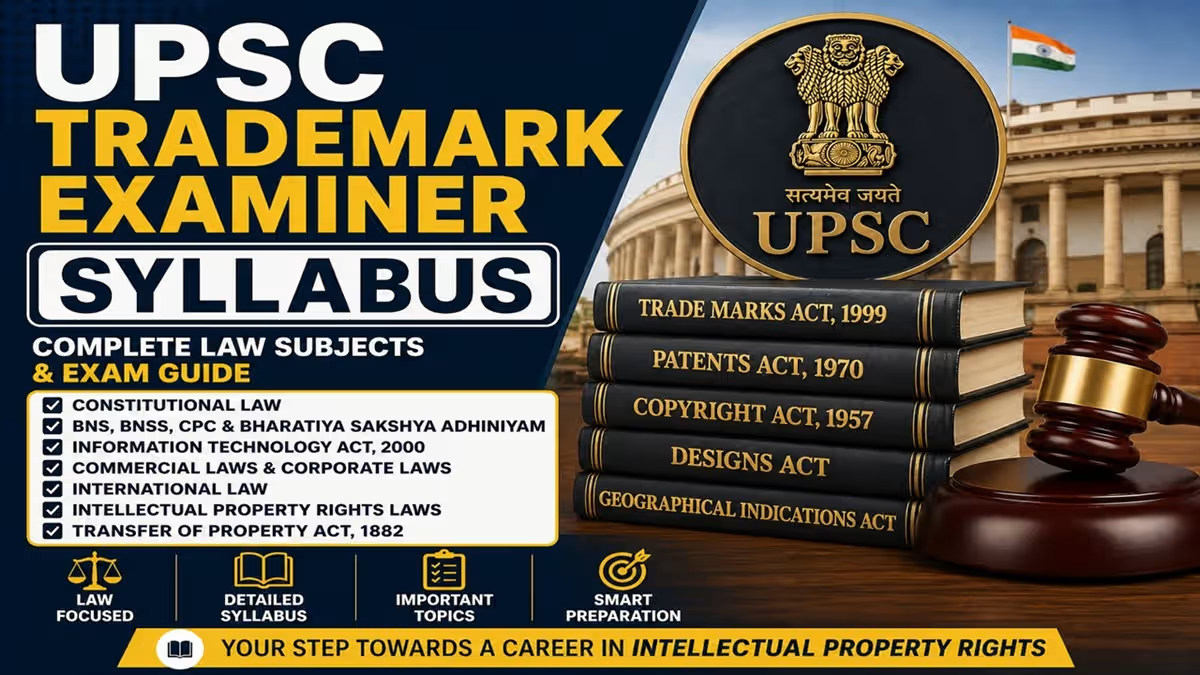
The UPSC Trademark Examiner Syllabus is a highly specialized and law-focused syllabus designed to test a candidate’s understanding of core legal subjects relevant to intellectual property and governance. Unlike many other competitive exams, the UPSC Trademark Examiner Syllabus does not include general aptitude areas like reasoning or quantitative ability. Instead, it is entirely centered on legal knowledge, making it particularly suitable for law graduates and aspirants preparing for legal and regulatory roles under the Government of India.
✅ UPSC Trademark Examiner Eligibility Details
Check the complete UPSC Trademark Examiner Eligibility criteria including educational qualification, age limit, experience requirements, nationality, age relaxation, and other important conditions before applying for the recruitment.
A major portion of the UPSC Trademark Examiner Syllabus is dedicated to Constitutional Law and newly introduced criminal laws such as the Bharatiya Nyaya Sanhita (BNS), Bharatiya Nagarik Suraksha Sanhita (BNSS), and Bharatiya Sakshya Adhiniyam (BSA). Along with these, candidates are expected to have a clear understanding of procedural laws like the Civil Procedure Code (CPC) and digital regulations under the Information Technology Act, 2000. The structured nature of the UPSC Trademark Examiner Syllabus ensures that questions are concept-based and often derived directly from Bare Acts.
If you are preparing based on the UPSC Trademark Examiner Syllabus, understanding the subject approach is crucial. This video playlist will help you build strong conceptual clarity for IPR laws included in the exam.
📚 Preparing for UPSC Trademark Examiner Exam? Start with the right guidance.
⚖️ This playlist is designed to help you understand core IPR laws.
UPSC Trademark Examiner Preparation Playlist:
🎥 Watch this complete playlist to strengthen your preparation and cover important topics effectively.
🚀 Highly useful for UPSC Trademark Examiner Exam, CGPDTM Patent Examiner Exam, Patent Agent Exam, Trademark Agent Exam & Law Exams.
🔥 Build strong conceptual clarity and boost your exam preparation.
After watching this playlist, you will have a much clearer understanding of the UPSC Trademark Examiner Exam Syllabus. Make sure to revise regularly and align your preparation strategy with the syllabus.
Another crucial component of the UPSC Trademark Examiner Exam Syllabus is Intellectual Property Rights (IPR) laws, which form the core of the examination. Laws such as the Trade Marks Act, 1999, Patents Act, 1970, and Copyright Act, 1957 carry significant weightage. Additionally, the UPSC Trademark Examiner Exam Syllabus also includes topics from Commercial Laws, Corporate Laws, International Law, and the Transfer of Property Act, ensuring a comprehensive evaluation of a candidate’s legal understanding in both domestic and global contexts.
This makes it a highly targeted opportunity for law aspirants who want to build a career in IPR and government services under CGPDTM.
UPSC Trademark Examiner Syllabus 2026
UPSC Trademark Examiner Exam Pattern
- Objective Type (MCQs)- 120 Questions
- Law-based questions only
- Focus on conceptual clarity + Bare Act knowledge
- Interview/Personality Test (may be conducted)
📘 How to Become a Trademark Agent in India
Start your journey towards a rewarding career in Intellectual Property Rights. Learn the complete step-by-step process, eligibility, and exam details to become a Trademark Agent in India.
UPSC Trademark Examiner Syllabus 2026 (Detailed)
Below is the updated and accurate syllabus, aligned with recent legal developments.
Constitutional Law
This section evaluates your understanding of the Indian constitutional framework and governance.
Important Topics:
- Salient features of the Constitution
- Preamble and its significance
- Fundamental Rights
- Directive Principles of State Policy (DPSP)
- Fundamental Duties
- Powers and functions of the President and Prime Minister
- Parliament and legislative process
- Judiciary and judicial review
- Federal structure and Centre–State relations
- Constitutional amendments
👉 This section is conceptual and scoring with proper revision.
BNS, BNSS, CPC & Bharatiya Sakshya Adhiniyam (High Weightage Section)
Due to recent legal reforms, this section has become extremely important.
Bharatiya Nyaya Sanhita (BNS), 2023
Replaces the IPC and defines criminal offences and liabilities.
Key Topics:
- Definition of offence and criminal liability
- Types of punishments
- General exceptions and mens rea
- Cheating, fraud, misappropriation, criminal breach of trust
- Economic offences and cyber crimes
- Abetment, attempt, and joint liability
👉 Questions are mostly conceptual and section-based.
Bharatiya Nagarik Suraksha Sanhita (BNSS), 2023
Replaces CrPC and governs criminal procedure.
Key Topics:
- Structure and powers of criminal courts
- FIR and investigation process
- Arrest, search, and seizure
- Bail and bond provisions
- Trial procedures
- Rights of accused and victims
Civil Procedure Code (CPC), 1908
Key Topics:
- Jurisdiction of civil courts
- Institution of suits
- Pleadings and interim orders
- Decrees and execution
- Appeals, revisions, and review
Bharatiya Sakshya Adhiniyam (BSA), 2023
Modern evidence law replacing the Indian Evidence Act.
Key Topics:
- Types of evidence
- Oral and documentary evidence
- Electronic and digital evidence
- Admissions and confessions
- Burden of proof
- Relevance and admissibility
👉 Digital evidence is highly important here.
Information Technology Act, 2000
With increasing digitalization, this section is highly relevant.
Key Topics:
- Electronic records and signatures
- Digital signature certificates
- Cyber offences and penalties
- Data protection and privacy
- Hacking and unauthorized access
- Powers of authorities
👉 Expect direct and section-based questions.
Commercial Laws & Corporate Laws
This section tests your understanding of business-related legal frameworks.
Commercial Laws:
- Indian Contract Act – essentials of a valid contract
- Sale of Goods Act – conditions and warranties
- Negotiable Instruments Act – cheque, promissory note, bill of exchange
- Partnership Act – rights and duties of partners
Corporate Laws:
- Companies Act
- Types of companies
- Incorporation and management
- Duties and liabilities of directors
- Corporate governance
👉 A basic conceptual understanding is sufficient.
International Law
This section focuses on legal principles governing international relations.
Important Topics:
- Nature and sources of international law
- Treaties and conventions
- State recognition and jurisdiction
- United Nations and its organs
- International Court of Justice (ICJ)
- Human rights
Intellectual Property Rights (IPR) Laws – MOST IMPORTANT
This is the core subject of the UPSC Trademark Examiner exam and carries the highest weightage.
Important Laws:
- Trade Marks Act, 1999
- Patents Act, 1970
- Copyright Act, 1957
- Designs Act, 2000
- Geographical Indications (GI) Act, 1999
- WIPO and global IPR framework
- WTO
- International Treaties
- National IPR Policy 2016
- Important Cases & Judgements
👉 Maximum questions are asked from this section, especially Patent Law & Trademark Law.
Transfer of Property Act, 1882
This section deals with transfer of immovable property.
Important Topics:
- Transfer of property
- Sale and exchange
- Mortgage and its types
- Lease and rights of parties
- Gift
- Actionable claims
- Doctrine of Lis Pendens
- Doctrine of Part Performance
Most Important Subjects (Priority Order)
- IPR Laws (Highest weightage)
- Trade Marks Act, 1999
- BNS / BNSS / BSA
- Constitutional Law
- IT Act
Preparation Strategy
Start with IPR
Trademark Law should be your strongest area.
Read Bare Acts
Most questions are section-based.
Focus on New Laws
BNS, BNSS, and BSA are crucial.
Practice MCQs
Solve previous year questions and mock tests.
Revise Regularly
Law requires continuous revision for retention.
Best Books for Preparation
- IPR Guru Study Notes
- Bare Acts (Must)
- Case Law Notes
Common Mistakes to Avoid
❌ Ignoring Bare Acts
❌ Not revising regularly
FAQs – UPSC Trademark Examiner Syllabus
Q1. Does the UPSC Trademark Examiner exam include GK or reasoning?
No, the exam is purely law-based.
Q2. Which subject is most important?
IPR Laws, especially the Trade Marks Act, 1999.
Q3. Are new criminal laws important?
Yes, BNS, BNSS, and BSA are highly important.
Q4. Is this exam suitable for non-law students?
It is primarily designed only for law graduates.
Q5. How to prepare effectively?
Focus on Bare Acts, revise regularly, and practice MCQs.
Overall, the UPSC Trademark Examiner Syllabus is designed to assess clarity of concepts, legal reasoning, and practical application of laws. Since the UPSC Trademark Examiner Syllabus is focused and predictable, candidates who consistently study Bare Acts, revise regularly, and practice application-based questions can perform well in the exam. A thorough understanding of the UPSC Trademark Examiner Syllabus is the first step toward building a strong preparation strategy and achieving success in this competitive examination.
If you are preparing for the UPSC Trademark Examiner Exam, you must clearly understand one thing — this is a pure law-based examination. The entire focus is on legal subjects, especially Intellectual Property Rights (IPR) and allied laws.
UPSC Trademark Examiner Syllabus PDF Download
📥 Download UPSC Trademark Examiner Syllabus PDF
Get the latest & exam-focused syllabus in a clean PDF format for
quick revision and smart preparation.
🚀 Useful for CGPDTM, Patent Agent, Trademark Agent, UPSC, CLAT PG, Judiciary, CA, CS & CMA Exams
Follow IPR Guru on Social Media
 LinkedIn LinkedIn |
 YouTube YouTube |
 Twitter (X) Twitter (X) |
 Facebook Facebook |
 Instagram Instagram |
 Telegram Telegram |
🎓 Join IPR Guru Academy
Register now to receive structured preparation for Patent Agent, Patent Examiner, Trademark Agent, and CGPDTM Exams, along with exclusive study resources, exam updates, and priority access to upcoming courses.
Register Now