Join our Official Telegram Channel to receive instant notifications, PDF notes, important announcements, and free study resources. Join Telegram →
The History of Intellectual Property Rights is a fascinating journey that reflects the evolution of human creativity, innovation, and legal protection. Every invention, artistic creation, trademark, design, or literary work begins with an original idea. Over time, societies realized that innovators and creators deserved legal recognition and exclusive rights over their intellectual creations. This realization gave birth to the modern system of Intellectual Property Rights (IPR). Understanding the History of Intellectual Property Rights helps us appreciate how today’s patent, copyright, trademark, and design laws have developed over centuries.
The History of Intellectual Property Rights did not begin with modern legislation. Instead, its roots can be traced back to ancient civilizations where artisans, craftsmen, and scholars used distinctive marks, symbols, and traditional practices to identify ownership and originality. From the Harappa Civilization and Ancient Greece to the Venetian Patent Statute of 1474, the History of Intellectual Property Rights demonstrates how societies gradually moved from informal recognition of creativity to structured legal protection. This historical evolution ultimately laid the foundation for the global intellectual property system that exists today.
📌 How to Become a Patent Agent in India?
Get complete details about the Patent Agent Exam 2027 including eligibility, syllabus, exam pattern, important dates, and preparation strategy in one place.
The History of Intellectual Property Rights continued to evolve through landmark legal developments such as the Statute of Monopolies (1623), the Statute of Anne (1710), the Paris Convention (1883), the Berne Convention (1886), the establishment of WIPO in 1967, and the TRIPS Agreement under the WTO in 1995. Each of these milestones significantly shaped international intellectual property protection by promoting innovation, encouraging technology transfer, and harmonizing legal standards across different countries. Therefore, studying the History of Intellectual Property Rights is essential for understanding the modern global IP framework.
In India, the History of Intellectual Property Rights has followed a unique path. While ancient India promoted knowledge sharing through the Guru-Shishya tradition, the formal legal framework began with Act VI of 1856 during British rule. Over time, several legislative reforms culminated in the Patents Act, 1970 and the TRIPS-compliant amendments of 1999, 2002, and 2005. Today, the History of Intellectual Property Rights serves as the foundation for India’s comprehensive IP ecosystem, which protects patents, copyrights, trademarks, industrial designs, geographical indications, plant varieties, semiconductor layout designs, and trade secrets.
📘 How to Become a Trademark Agent in India
Start your journey towards a rewarding career in Intellectual Property Rights. Learn the complete step-by-step process, eligibility, and exam details to become a Trademark Agent in India.
This comprehensive guide explores the History of Intellectual Property Rights from its earliest origins to the present-day legal framework in India and across the world. Whether you are a law student, researcher, entrepreneur, innovator, or preparing for the Patent Agent Examination, Trademark Agent Examination, CGPDTM Patent Examiner Recruitment, CLAT, Judiciary, UPSC Trademark Examiner Recruitment, CA Final, CS Professional, or CMA Final, understanding the History of Intellectual Property Rights is essential for both academic learning and professional success.
History of Intellectual Property Rights in India
What are Intellectual Property Rights?
Intellectual Property Rights are legal rights granted to creators and innovators over their intellectual creations. These creations may include inventions, literary works, artistic works, trademarks, industrial designs, geographical indications, trade secrets, and plant varieties.
Unlike physical property, intellectual property originates from human intelligence and creativity. Governments grant exclusive rights to encourage innovation while ensuring that society ultimately benefits from technological and creative progress.
Stay Connected With Us
Get the latest IPR updates, free classes, mock tests, and exam notifications.
Early Origins of Intellectual Property
Although modern IP laws did not exist in ancient times, civilizations recognized the value of originality and ownership.
Harappa Civilization (c. 2600–1900 BCE)
Archaeological discoveries from the Harappa Civilization reveal pottery marks and seals that identified the origin of goods. These marks resembled modern trademarks by distinguishing products created by different artisans. They demonstrate one of the earliest examples of recognizing commercial identity.
Ancient Greece (500 BCE)
One of the earliest recorded examples of exclusive rights comes from the Greek city of Sybaris. According to historical accounts, cooks who invented unique dishes were granted a one-year exclusive right to prepare and sell them. This encouraged creativity and rewarded innovation, making it one of the earliest patent-like concepts.
Ancient India
Ancient India witnessed remarkable advancements in Ayurveda, mathematics, astronomy, metallurgy, architecture, and literature. Knowledge was primarily transmitted through the Guru-Shishya tradition and oral learning. Instead of exclusive ownership, society emphasized preserving and sharing knowledge for public welfare.
History of Modern Intellectual Property Laws
Venetian Patent Statute (1474)
The Republic of Venice enacted the world’s first formal patent statute in 1474. Inventors who developed new and useful inventions received exclusive protection for ten years after disclosing their inventions to the authorities.
This statute introduced several principles that remain fundamental to modern patent systems:
- Novelty
- Disclosure
- Exclusive Rights
- Legal remedies against infringement
The Venetian Patent Statute is widely regarded as the foundation of modern patent law.
Statute of Monopolies (1623)
Before this Act, the English Crown frequently granted monopolies as royal privileges. The Statute of Monopolies restricted such arbitrary grants and reserved patent protection for genuine inventors.
The Act established:
- Protection only for true inventors
- Patent term of 14 years
- Foundation of modern English patent law
Its principles influenced patent legislation across many common-law countries.
Statute of Anne (1710): Birth of Copyright Law
The invention of the printing press increased the need to protect authors from unauthorized copying.
The British Parliament enacted the Statute of Anne in 1710, considered the world’s first copyright law. It granted authors exclusive rights to publish and reproduce their works for an initial term of 14 years, with an option for renewal.
This legislation shifted protection from printers to authors and laid the foundation for modern copyright systems.
International Development of Intellectual Property
As international trade expanded, countries recognized the need for cross-border protection of intellectual property.
Paris Convention (1883)
The Paris Convention became the first major international treaty for industrial property. It introduced the principle of priority rights, allowing inventors to file applications in multiple member countries while retaining the original filing date.
Berne Convention (1886)
The Berne Convention established international protection for literary and artistic works. It introduced principles such as national treatment and automatic copyright protection.
BIRPI (1893)
The United International Bureaux for the Protection of Intellectual Property (BIRPI) was established in Switzerland to administer international IP agreements.
WIPO (1967)
In 1967, BIRPI evolved into the World Intellectual Property Organization (WIPO). Today, WIPO functions as a specialized agency of the United Nations, promoting global cooperation, harmonization of IP laws, and international registration systems.
WTO and TRIPS Agreement
The establishment of the World Trade Organization (WTO) transformed international intellectual property protection through the Agreement on Trade-Related Aspects of Intellectual Property Rights (TRIPS).
TRIPS introduced:
- Minimum global standards for IP protection
- Twenty-year patent term
- Effective enforcement mechanisms
- Protection across all fields of technology
These standards significantly influenced patent reforms worldwide.
Evolution of Intellectual Property Laws in India
Act VI of 1856
India’s first formal patent legislation was enacted in 1856 based on the British Patent Law of 1852. It granted inventors exclusive rights for 14 years but was repealed shortly afterward due to procedural issues.
Act IX of 1857
The Act addressed deficiencies in the earlier legislation and introduced a more structured framework for intellectual property administration in India.
Patterns and Designs Protection Act, 1872
This legislation represented India’s first comprehensive intellectual property law and provided protection for inventions and industrial designs.
Protection of Inventions Act, 1883
The Act strengthened patent protection by introducing novelty requirements, utility standards, grace periods, and better enforcement provisions.
Inventions and Designs Act, 1888
This Act consolidated earlier patent legislation and streamlined administrative procedures while incorporating developments from British patent law.
Indian Patents and Designs Act, 1911
The 1911 Act unified patent and industrial design law in India and remained the principal legislation until Independence. It introduced provisions relating to novelty, utility, licensing, infringement remedies, and penalties.
Post-Independence Patent Reforms
After Independence, India’s patent policy shifted toward balancing innovation with public interest.
Major developments included:
- Tek Chand Committee (1949)
- Compulsory licensing provisions (1950)
- Ayyangar Committee recommendations
- Emphasis on affordable medicines
- Promotion of indigenous innovation
These reforms eventually resulted in the landmark Patents Act, 1970.
The Patents Act, 1970
The Patents Act, 1970 transformed India’s patent regime by abolishing product patents in pharmaceuticals and permitting only process patents in critical sectors.
This policy enabled the growth of India’s pharmaceutical industry and improved access to affordable medicines while encouraging domestic innovation.
TRIPS-Compliant Patent Amendments
To comply with TRIPS, India introduced significant amendments in:
- 1999
- 2002
- 2005
The 2005 amendment restored product patents for pharmaceuticals, chemicals, and food products, making India’s patent system fully TRIPS compliant.
Present Intellectual Property Framework in India
India now has a comprehensive IP regime comprising:
- Patents Act, 1970
- Trade Marks Act, 1999
- Copyright Act, 1957
- Designs Act, 2000
- Geographical Indications Act, 1999
- Semiconductor Integrated Circuits Layout-Design Act, 2000
- Protection of Plant Varieties and Farmers’ Rights Act, 2001
These laws aim to foster innovation while balancing the interests of creators and society.
History of Intellectual Property Rights in the World
The history of Intellectual Property Rights demonstrates humanity’s continuous effort to reward creativity while promoting social progress. From ancient pottery marks in the Harappa Civilization and the early exclusivity granted in Ancient Greece to modern treaties such as the Paris Convention, Berne Convention, WIPO, WTO, and TRIPS, the IP system has evolved into a sophisticated legal framework that supports innovation across the globe.
India’s journey—from the Patent Act of 1856 to the modern TRIPS-compliant regime—reflects the country’s commitment to balancing innovation, economic growth, public health, and global obligations. As technology continues to evolve, Intellectual Property Rights will remain central to encouraging research, protecting creativity, and driving sustainable development.
History of Intellectual Property Rights in the World & India
The history of Intellectual Property Rights reflects the gradual evolution of legal systems designed to protect innovation, creativity, and commercial identity. Understanding the history of Intellectual Property Rights helps us appreciate how societies recognized the importance of rewarding inventors, authors, artists, and traders. The history of IPR is closely connected with the development of trade, technology, literature, and industrial progress across different civilizations. Today, studying the history of intellectual property law is essential for anyone preparing for competitive examinations or pursuing a career in intellectual property.
The history of Intellectual Property Rights can be traced back to ancient civilizations, where symbols, seals, and marks were used to identify ownership and authenticity of goods. Over time, the history of IPR witnessed significant milestones such as the Venetian Patent Statute of 1474, the Statute of Anne of 1710, and the Paris and Berne Conventions. These developments shaped the modern framework of intellectual property protection. Therefore, the history of intellectual property law is not limited to patents alone but also includes copyrights, trademarks, industrial designs, and other forms of intellectual property.
In India, the history of Intellectual Property Rights has evolved through ancient practices, colonial legislation, and modern statutory reforms. The history of IPR in India includes the enactment of various laws governing patents, trademarks, copyrights, geographical indications, and plant varieties. After joining international agreements such as the TRIPS Agreement, India’s history of intellectual property law entered a new phase with significant amendments to align domestic laws with global standards while balancing public interest and innovation.
A comprehensive understanding of the history of Intellectual Property Rights enables students and professionals to analyze the evolution of legal principles that govern intellectual creations. Whether preparing for the Patent Agent Examination, Trademark Agent Examination, Judiciary, UPSC, or law entrance tests, knowledge of the history of IPR provides a strong conceptual foundation. Since many examination questions are based on historical developments and landmark legislations, studying the history of intellectual property law is indispensable for building expertise in the field of intellectual property.
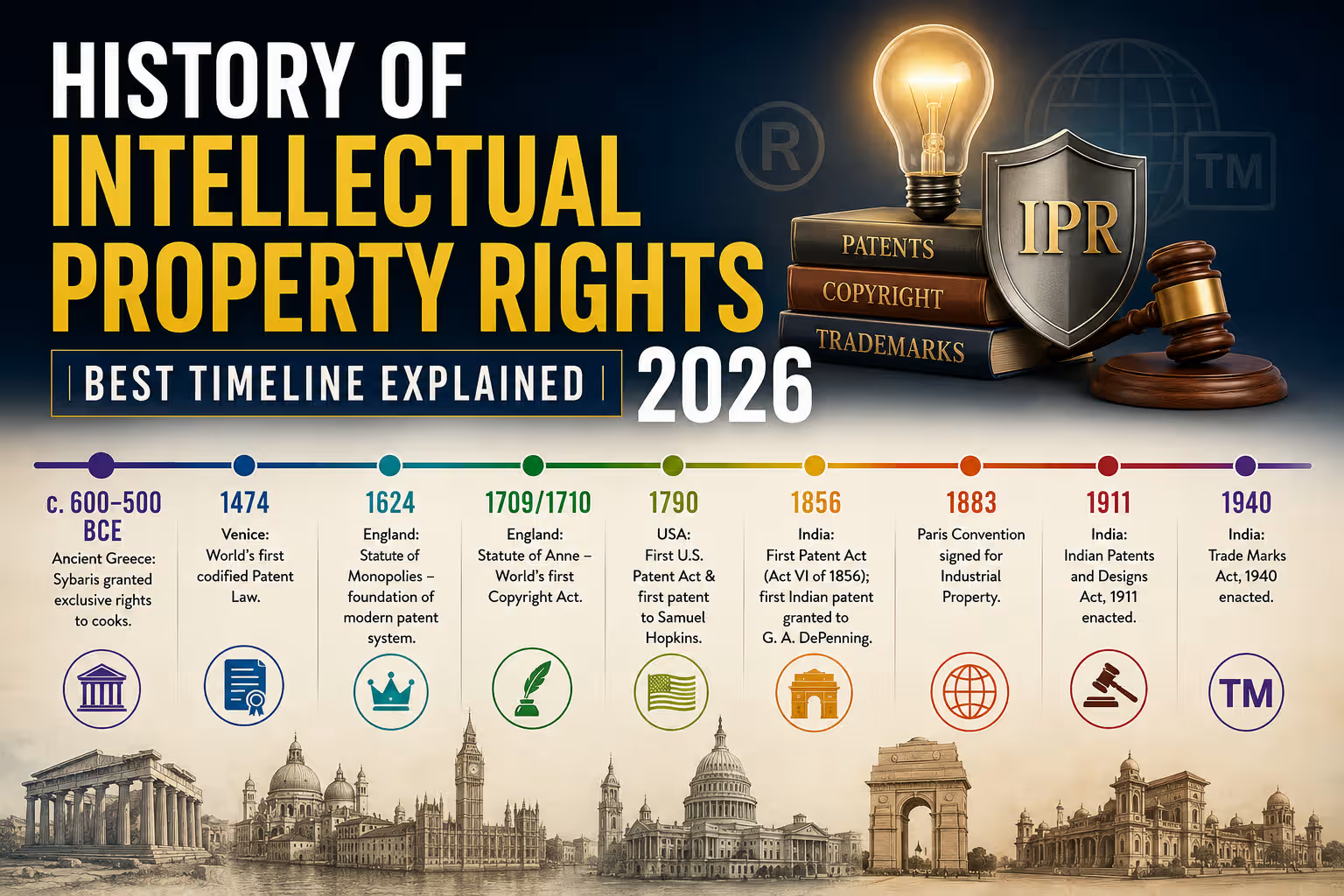
| Year / Period | Event / Development | Country / Organization | Historical Development | Historical Significance |
|---|---|---|---|---|
| 2600–1900 BCE | Harappa Civilization | India | Pottery marks, seals and symbols were used to identify the origin of goods and artisans. | Earliest Trademark-like Concept |
| Ancient India | Traditional Knowledge System | India | Ayurveda, Vedas, metallurgy, guild marks, handicrafts and traditional knowledge reflected early concepts of Intellectual Property through community ownership. | Traditional Knowledge & Community Innovation |
| Ancient India | Guru–Shishya Tradition | India | Knowledge was transmitted orally through the Guru–Shishya tradition without exclusive ownership or monopoly over ideas. | Knowledge Sharing Tradition |
| c. 600–500 BCE | Sybaris Exclusive Rights | Ancient Greece | The city of Sybaris granted cooks exclusive rights for one year over newly invented dishes. | Earliest Patent-like Right |
| 14th Century | Craft Guilds | Europe | Craft guilds protected trade secrets, manufacturing techniques and professional know-how. | Early Trade Secret Protection |
| 1474 | Venetian Patent Statute | Venice | World’s first codified Patent Law granting inventors exclusive rights for a limited period. | First Codified Patent Law |
| 1557 | Stationers’ Company Charter | England | Established the first organized copyright registration and printing control system. | Early Copyright Registration |
| 1624 | Statute of Monopolies | England | Restricted royal monopolies and laid the foundation of the modern patent system. | Foundation of Modern Patent Law |
| 1709/1710 | Statute of Anne | England | World’s first Copyright Act granting rights to authors instead of publishers. | First Copyright Law |
| 1787 | U.S. Constitution | USA | Empowered Congress to grant patents and copyrights to promote science and useful arts. | Constitutional Recognition of IP |
| 1790 | First U.S. Patent Act | USA | First U.S. Patent Act enacted; first patent granted to Samuel Hopkins. | Beginning of U.S. Patent System |
| 1791 | French Patent Law | France | Patent law enacted after the French Revolution recognizing inventors’ rights. | Modern National Patent Law |
| 1836 | United States Patent Office | USA | Modern patent examination system introduced with establishment of the Patent Office. | Patent Administration |
| 1852 | British Patent Law | Britain | Centralized the British patent system and later became the basis of India’s Patent Act. | Patent Law Reform |
| 1856 | Act VI of 1856 | India | First Patent Act of India enacted; first Indian patent granted to George Alfred DePenning. | Beginning of Indian Patent Law |
| 1859 | Act XV of 1859 (Replaced the earlier Act) | India | Rights renamed “Exclusive Privileges”; priority period increased from 6 to 12 months; importers excluded from the definition of inventor. | Early Patent Reform |
| 1872 | The Patterns and Designs Protection Act, 1872 (Act XIII of 1872) | India | Introduced legal protection for industrial designs. | Design Protection |
| 1875 | Trade Marks Registration Act | Britain | Established the world’s first official trademark registration system and created the Register of Trade Marks. | World’s First Trademark Registration System |
| 1876 | Bass Red Triangle Registered (Bass Brewery Beer Company) | Britain | The Bass Red Triangle became the world’s first registered trademark (Registration No. 1). | World’s First Registered Trademark |
| 1883 | The Patterns and Designs Protection Amendment Act (Act XVI of 1883)
Paris Convention |
India / International | Introduced novelty and six-month grace period in India; Paris Convention signed for the Protection of Industrial Property. | International Industrial Property Protection |
| 1886 | Berne Convention | International | Convention signed for the Protection of Literary and Artistic Works. | International Copyright Protection |
| 1888 | Inventions and Designs Act | India | Consolidated patent and design laws in India. | Patent & Design Reform |
| 1891 | Madrid Agreement | International | Adopted for the International Registration of Trademarks. | International Trademark Registration |
| 1893 | BIRPI Established | International | United International Bureaux for the Protection of Intellectual Property (BIRPI) established to administer the Paris and Berne Conventions. | International IP Administration |
| 1911 | Indian Patents and Designs Act | India | Comprehensive patent legislation enacted; Office of the Controller of Patents established. | Modern Indian Patent Administration |
| 1914 | Copyright Act | India | First comprehensive copyright legislation enacted in India. | Copyright Protection |
| 1930 | Patent of Addition | India | Patent of Addition introduced; Government use provisions added; patent term extended to sixteen years. | Patent Expansion |
| 1940 | Trade Marks Act | India | First Trade Marks Act enacted; Trade Marks Registry established. | Trademark Protection |
| 1945 | Patent Procedure Reform | India | Provisions relating to Provisional Specification and Complete Specification introduced. | Improved Patent Filing Procedure |
| 1947 | GATT Established | International | General Agreement on Tariffs and Trade (GATT) established to promote international trade. | Foundation of Global Trade System |
| 1949 | Bakshi Tek Chand Committee | India | Committee appointed to review and reform the Indian patent system. | Patent Law Review |
| 1950 | Working Statement & Licence of Right | India | Working Statement and Licence of Right provisions introduced. | Patent Procedure Reform |
| 1952** | Compulsory Licensing | India | Compulsory Licensing introduced for food, medicines and insecticides. | Public Interest Protection |
| 1957 | Justice Ayyangar Committee Report | India | Committee submitted landmark report; Copyright Act, 1957 enacted. | Foundation of Modern Indian Patent Law |
| 1958 | Trade and Merchandise Marks Act | India | Replaced the Trade Marks Act, 1940. | Trademark Law Reform |
| 1965 | Patent Bill | India | New Patent Bill introduced in Lok Sabha. | Legislative Reform |
| 1967 | WIPO Established | International / India | World Intellectual Property Organization (WIPO) established; Indian Patent Bill referred again to the Parliamentary Committee. | International IP Governance |
| 1970 | Patents Act, 1970 & PCT | India / International | Patents Act, 1970 enacted; Patent Cooperation Treaty (PCT) adopted internationally. | Modern Patent System |
| 1972 | Patents Rules, 1972 | India | Patents Act, 1970 came into force along with the Patents Rules, 1972. | Implementation of Patent Law |
| 1978 | UPOV Convention (1978 Act) | International | International Convention adopted for the Protection of New Varieties of Plants. | Plant Variety Protection |
| 1984 | Copyright Amendment | India | Strengthened penalties for repeat copyright infringement. | Stronger Copyright Enforcement |
| 1991 | Sui Generis Decision | India | Decision taken to introduce a sui generis system for Plant Variety Protection. | Plant Variety Protection Policy |
| 1994 | TRIPS Agreement | International / India | TRIPS Agreement signed; registration of Copyright Societies made mandatory in India. | Global IP Standards |
| 1995 | WTO Established | International / India | World Trade Organization established; TRIPS came into force; India received a transition period (1995–2005). | Global IP Enforcement |
| 1999 | First Patent Amendment | India | Mailbox facility and Exclusive Marketing Rights (EMR) introduced; Trade Marks Act, 1999 and Geographical Indications of Goods (Registration and Protection) Act, 1999 enacted. | TRIPS Compliance |
| 2000 | Designs Act & SICLD Act | India | Designs Act, 2000 and Semiconductor Integrated Circuits Layout-Design Act, 2000 enacted. | Expansion of IP Laws |
| 2001 | PPV&FR Act | India | Protection of Plant Varieties and Farmers’ Rights Act, 2001 enacted; Designs Rules, 2001 and SICLD Rules, 2001 notified. | Protection of Plant Varieties |
| 2002 | Second Patent Amendment | India | Second Patent Amendment; Trade Marks Rules, 2002; GI Rules, 2002; Biological Diversity Act, 2002 enacted. | Strengthening IP Framework |
| 2003 | Patents Rules, 2003 | India | Patents Rules, 2003 notified; GI Act came into force; National Biodiversity Authority established. | Effective IP Administration |
| 2004 | Biological Diversity Rules | India | Biological Diversity Rules, 2004 notified. | Biodiversity Protection |
| 2005 | Third Patent Amendment | India | Product patents introduced in all fields; Section 3(d); Pre-grant and Post-grant Opposition incorporated. | TRIPS-Compliant Patent System |
| 2012 | Copyright Amendment | India | Major reforms relating to digital rights, performers’ rights, royalties and accessibility. | Digital Copyright Reform |
| 2013 | Copyright Rules | India | Copyright Rules, 2013 notified. | Procedural Reform |
| 2014 | Marrakesh Treaty | International | Treaty came into force to facilitate access to published works for visually impaired persons. | Accessibility in Copyright |
| 2016 | Madrid Protocol | India | India acceded to the Madrid Protocol for the International Registration of Trademarks. | Global Trademark Integration |
| 2017 | Trade Marks Rules | India | Trade Marks Rules, 2017 replaced the Trade Marks Rules, 2002. | Trademark Procedure Reform |
| 2021 | Tribunals Reforms Act | India | Intellectual Property Appellate Board (IPAB) abolished; jurisdiction transferred to the High Courts. | Judicial Reform |
| 2023 | Jan Vishwas Act & Biological Diversity (Amendment) Act | India | Jan Vishwas (Amendment of Provisions) Act, 2023 decriminalized several IP-related offences; Biological Diversity (Amendment) Act, 2023 enacted. | Ease of Doing Business & IP Reform |
**Based on these amendments (Till 1952), a bill was presented in the parliament in 1953 but was rejected.
1959 – The Ayyangar Committee submitted its report to the Government in 1959. The report was divided into two parts:
1. General Aspects of Patent Law – Recommendations for improving and strengthening the Indian patent system.
2. Review of the Patent Bill, 1953 – Analysis and recommendations on the Patent Bill, 1953, which had earlier been rejected.
1965 – Based on the recommendations of the Ayyangar Committee, a revised Patent Bill was introduced in the Lok Sabha in 1965.
1970 – Patents Act, 1970 enacted (passed).
20 April 1972 – Patents Act, 1970 came into force.
1911 Design Provisions – Continued for designs until 1994.
2000 – Designs Act, 2000 enacted (effective from 11 May 2001).
Paris Convention, Berne Convention, Madrid Agreement, BIRPI, GATT, WIPO, TRIPS, WTO
| Year | Event | Why Was It Introduced? (Purpose / Need) |
|---|---|---|
| 1883 | Paris Convention for the Protection of Industrial Property | During the 19th century, inventors and industrialists faced a major problem when taking their inventions abroad. Patents, trademarks, and industrial designs were not protected outside their home countries, allowing others to copy them freely. To solve this problem, countries adopted the Paris Convention, the first international treaty for the protection of Patents, Trademarks, Industrial Designs, Utility Models, Trade Names, and other Industrial Property. It introduced key principles such as National Treatment, Right of Priority, and Independence of Patents. |
| 1886 | Berne Convention for the Protection of Literary and Artistic Works | The Paris Convention protected only Industrial Property and did not cover literary or artistic works. Authors, poets, musicians, painters, and artists found that their works were being copied in other countries without permission. The Berne Convention was therefore adopted to provide international copyright protection without requiring registration. It established the principles of Automatic Protection, National Treatment, and Minimum Standards of Copyright Protection. |
| 1891 | Madrid Agreement | Registering a trademark separately in every country was expensive, time-consuming, and complicated. The Madrid Agreement introduced an international trademark registration system, allowing applicants to seek protection in multiple member countries through a single international application. Today, this system is known as the Madrid System. |
| 1893 | BIRPI (United International Bureaux for the Protection of Intellectual Property) | After the adoption of the Paris Convention (1883) and the Berne Convention (1886), an international organization was needed to administer these treaties, maintain records, organize meetings, and coordinate among member countries. Therefore, BIRPI was established in 1893. It later evolved into the World Intellectual Property Organization (WIPO) in 1967. |
| 1947 | GATT (General Agreement on Tariffs and Trade) | Following World War II, countries wanted to promote international trade by reducing tariffs and other trade barriers. The GATT was established to facilitate free and fair global trade. Although it was not an Intellectual Property agreement, it laid the foundation for international trade, which later highlighted the need for uniform protection of Intellectual Property Rights. |
| 1967 | World Intellectual Property Organization (WIPO) | As Intellectual Property became increasingly important worldwide, the responsibilities of BIRPI expanded beyond its original capacity. To strengthen international cooperation in the protection and promotion of Intellectual Property, WIPO was established in 1967. In 1974, WIPO became a Specialized Agency of the United Nations (UN). |
| 1970 | Patent Cooperation Treaty (PCT) | Inventors seeking patent protection in multiple countries had to file separate patent applications in each country, making the process costly and complex. The Patent Cooperation Treaty (PCT) simplified this process by allowing applicants to file one International Patent Application, which could later be pursued in multiple member countries. |
| 1994 | TRIPS Agreement (Trade-Related Aspects of Intellectual Property Rights) | During the negotiations for establishing the World Trade Organization (WTO), developed countries insisted that international trade should be supported by uniform minimum standards of Intellectual Property protection. As a result, the TRIPS Agreement was adopted. It established minimum standards for the protection and enforcement of Patents, Trademarks, Copyrights, Geographical Indications (GI), Industrial Designs, Trade Secrets, Integrated Circuit Layout Designs, and other forms of Intellectual Property. |
| 1995 | World Trade Organization (WTO) | The WTO was established on 1 January 1995, and the TRIPS Agreement entered into force simultaneously. As a condition of WTO membership, all member countries, including India, became legally bound to comply with TRIPS. India was granted a 10-year transition period (1995–2005) to amend its domestic Intellectual Property laws and bring them into compliance with TRIPS. |
History of IPR: FAQs
Q1. What is the history of Intellectual Property Rights?
The history of IPR dates back to ancient civilizations, but modern legal protection began with the Venetian Patent Statute of 1474 and has evolved through international treaties and national laws.
Q2. What was India’s first patent law?
India’s first formal patent legislation was Act VI of 1856.
Q3. Which is the first copyright law in the world?
The Statute of Anne, enacted in England in 1710.
Q4. What is the importance of TRIPS?
TRIPS establishes minimum global standards for intellectual property protection and enforcement among WTO member countries.
Q5. Which law governs patents in India today?
The Patents Act, 1970, as amended (most notably in 2005), governs patents in India.
📚 Continue Your Learning
Watch the complete Patent Agent Examination 2027 Free Course or access all class PDF notes.
🎓 Join IPR Guru Academy
Register now to receive structured preparation for Patent Agent, Patent Examiner, Trademark Agent, and CGPDTM Exams, along with exclusive study resources, exam updates, and priority access to upcoming courses.
Register Now