Join our Official Telegram Channel to receive instant notifications, PDF notes, important announcements, and free study resources. Join Telegram →
What is a Patent: In today’s fast-moving world, innovation is the backbone of economic growth. Every new product, technology, or creative solution we see around us is the result of someone’s imagination and hard work. But innovation needs protection—otherwise, anyone could copy an idea and benefit from it without permission. This is where patents come into the picture. Patents are one of the most important components of Intellectual Property Rights (IPR) and play a key role in encouraging creativity, investment, and technological advancement.
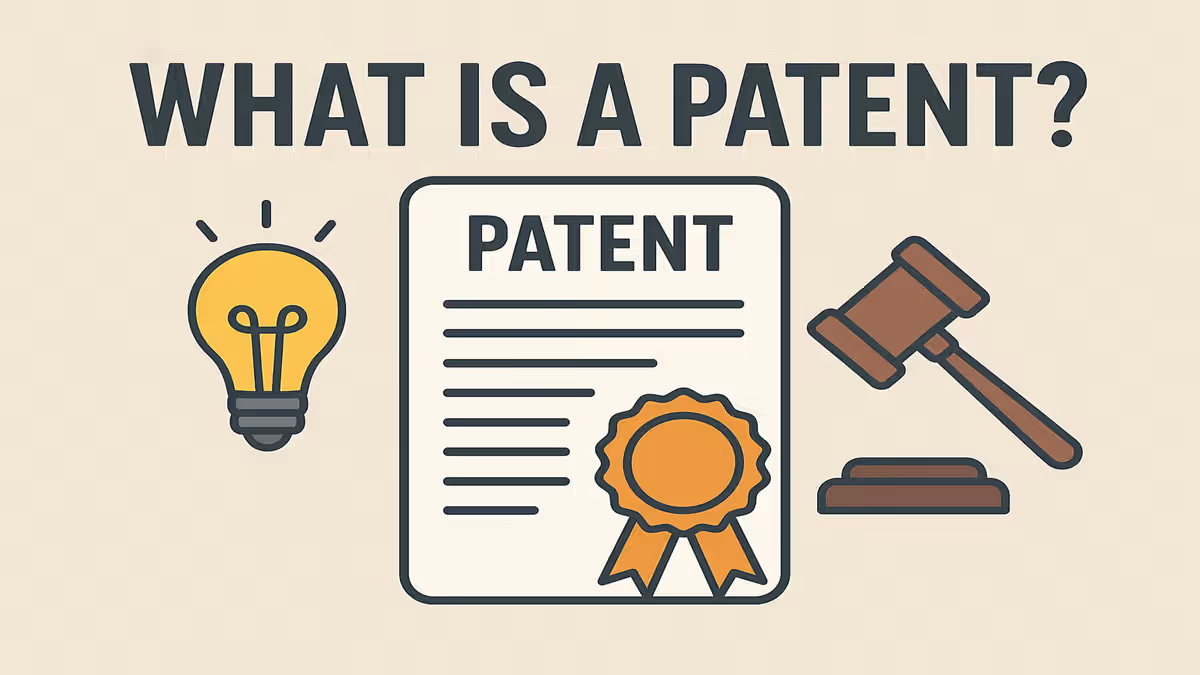
A patent is a legal right granted by the government to an inventor, giving them exclusive rights over their invention for a specific period, usually 20 years. During this time, the inventor has the authority to prevent others from making, using, selling, or importing the patented invention without permission. In return for this protection, the inventor must publicly disclose the details of the invention. This system creates a balance between rewarding innovation and promoting the sharing of knowledge with society.
Learn the basic concept of What is a Patent in a simple and easy-to-understand manner through this video. This is perfect for beginners, students, and anyone starting their journey in Intellectual Property Rights (IPR).
📘 Understand the Patents Act, 1970 – Complete Beginner’s Guide
Learn the fundamentals of the Patents Act, 1970, including the meaning of a patent, key definitions, important sections, patentability criteria, rights of patentees, and other essential concepts explained in a simple and easy-to-understand manner.
▶ Watch Complete Patent Act VideoWatch the full video to understand how patents protect inventions and encourage innovation. It will help you build a strong foundation for exams and practical understanding of patent law.
Patents are granted only when an invention meets certain essential criteria—novelty, inventive step, and industrial applicability. This means the invention must be new, not obvious to someone skilled in the field, and capable of being used in industry. These requirements ensure that only genuine innovations receive protection, thereby maintaining the quality and credibility of the patent system.
Stay Connected With Us
Get the latest IPR updates, free classes, mock tests, and exam notifications.
Another important aspect of patents is their role in business and commercialization. A patent is not just a legal document; it is also a valuable asset. Companies and inventors can license their patents, sell them, or use them to attract investors and funding. In many cases, patents form the foundation of startups and technology-driven businesses, giving them a competitive advantage in the market.
For students and aspirants preparing for Patent Agent, Trademark Agent, UPSC, Judiciary, and other law exams, understanding patents is crucial. Questions related to patentability, rights of patentees, and the patent process are commonly asked in exams. Beyond exams, this knowledge is equally important for practical careers in law, innovation, research, and entrepreneurship, making patents a core topic in the field of Intellectual Property Rights.
📘 How to Prepare For Patent Agent Exam 2027?
Before starting preparation for the Patent Agent Exam, go through the complete guide to understand the exam structure, eligibility, syllabus, and important topics. 👉 Check Patent Agent Exam GuidePatents not only protect inventors but also encourage businesses and investors to fund new ideas. When innovators know their work is legally safeguarded, they are more likely to invest time, money, and effort into research and development. This leads to the creation of new technologies, medicines, and solutions that improve our daily lives. Without patent protection, many groundbreaking inventions might never reach the market due to fear of copying and financial loss.
🎥 Watch: What is a Patent? (Simple Explanation for Beginners) If you are preparing for Patent Examiner, Trademark Examiner, Patent Agent, Trademark Agent, Judiciary, UPSC, or any Law Exams, understanding the basic concept of a patent is essential. 📌 Pro Tip: Exams often test both definition and conceptual clarity, so focus on understanding rather than memorizing. Continue reading to learn about types of patents and patentability criteria in detail.Moreover, patents contribute significantly to economic development and global competitiveness. Countries with strong patent systems tend to attract more innovation-driven industries and foreign investments. They also promote a culture of research, learning, and technological progress. In this way, patents not only benefit individual inventors but also drive national growth and societal advancement.
In this blog, we explore what is a patent, why it matters, how it works, and what counts as a patentable invention. If you’re new to IPR or want a simple explanation, this guide is for you.
What is a Patent?
Patent Meaning
A patent is a legal right granted by the government to an inventor for a limited period. It gives the inventor exclusive rights over their invention—meaning no one else can make, use, sell, or import the patented invention without permission. A patent is a exclusive right granted by the government to a patentee, which gives the patentee exclusive rights over an invention for a limited period of time. It means that the patentee can commercially make, use, sell, offer for sale, or import the invention and can prevent others from doing so without permission.
Patent Definition
In simple terms, What is a Patent: A patent is a protection for an invention. It ensures that only the inventor (or someone they authorize) can commercially use the invention. In return, inventors must fully disclose the details of their invention in the patent application so society can learn from it.
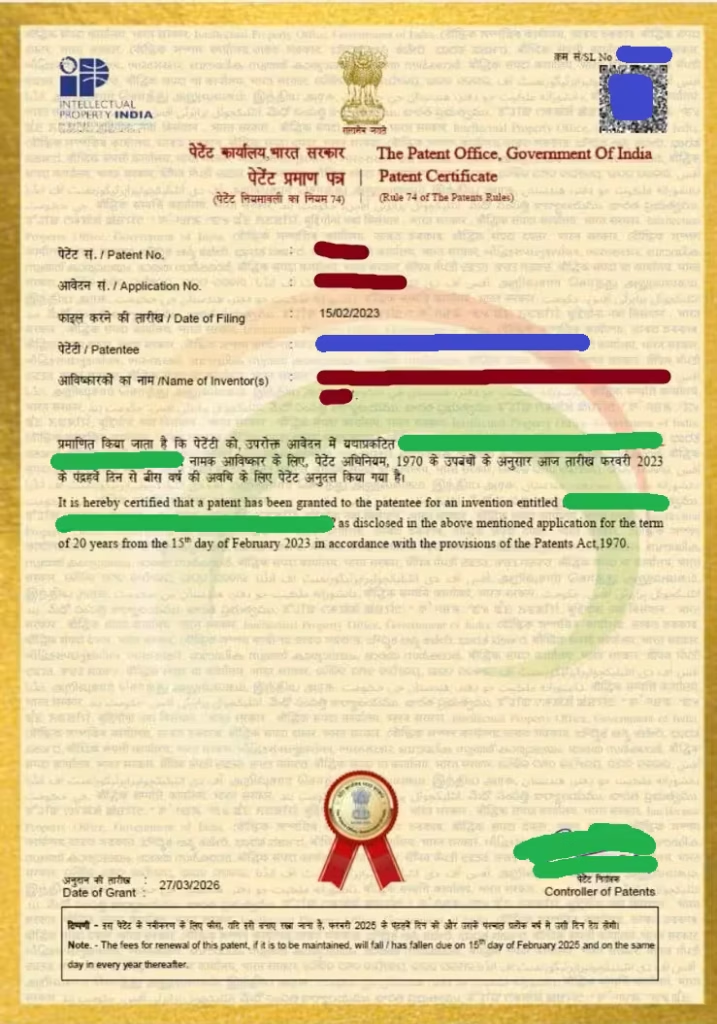
👉 Now the question arises: How are these rights granted?
The answer lies in the governing law related to patents. In India, these rights are conferred under the provisions of the Patents Act, 1970, which legally defines and grants the exclusive rights available to a patentee.
As per the Patents Act, 1970, Section – 2 (1)(f)- “exclusive licence” means a licence from a patentee which confers on the licensee, or on the licensee and persons authorised by him, to the exclusion of all other persons (including the patentee), any right in respect of the patented invention, and “exclusive licensee” shall be construed accordingly.
👉 Now the next question arises: what kind of invention is eligible for a patent?
As per the Patents Act, 1970, Section – 2 (1)(j)- “invention” means a new product or process involving an inventive step and capable of industrial application.
Patents encourage innovation because inventors know their ideas won’t be stolen. This creates a healthy cycle of innovation, knowledge-sharing, and economic growth.
Why Understanding What is a Patent is Important?
Patents serve several crucial purposes:
1. They Protect Innovation
If someone spends years researching and experimenting to create something new, it’s only fair they get credit—and control over its use.
2. They Create a Competitive Advantage
A patent can give a company a strong market position by preventing competitors from copying their product or technology.
3. They Encourage Investment
Investors feel more confident funding a start-up or new idea if the invention is protected by a patent.
4. They Promote Public Knowledge
Every patent is published, becoming a valuable source of technical information for students, researchers, and other innovators.
5. They Support Economic Development
Countries with strong patent systems often have more innovation, more R&D activity, and stronger industries.
What Can Be Patented?
Not every idea can be patented. Only those inventions that meet specific criteria qualify. As per the Patents Act, 1970, Section – 2 (1)(j)- “invention” means a new product or process involving an inventive step and capable of industrial application.
Also Read: 👉 Understanding B1 Patent Specification in India (New Granted Patent Format)
Generally, an invention must fulfill the following three requirements:
1. Novelty
The invention must be new.
It should not have been previously published, used, or known anywhere in the world before the filing date.
2. Inventive Step (Non-Obviousness)
The invention must involve creativity.
It should not be something obvious to a skilled person working in the same field.
3. Industrial Applicability (Usefulness)
The invention must be capable of being used in some industry.
This means it must have a practical purpose and should be workable.
Examples of Patentable Inventions
-
A new type of mobile battery with longer life
-
A machine that improves agricultural productivity
-
A pharmaceutical drug formula
-
A new manufacturing process
-
Software that produces a technical effect (varies by country)
What Cannot Be Patented?
Under the Patents Act, 1970, certain inventions are specifically excluded from patentability under Sections 3 and 4. These are not considered “inventions” in the legal sense in India. Or if an invention falls under Section 3 or 4 of the Patents Act, 1970, it is not eligible for patent protection in India, even if it appears new or innovative. Most countries exclude the following:
List of Non Patentable Inventions under Patents Act Section 3
| Clause | Category | Short Description |
|---|---|---|
| 3(a) | Frivolous inventions | Contrary to well-established natural laws |
| 3(b) | Against public order/morality | Harmful to life, health, or environment |
| 3(c) | Discovery | Scientific principle or natural substance |
| 3(d) | New form of known substance | No enhanced efficacy |
| 3(e) | Mere admixture | No synergistic effect |
| 3(f) | Mere arrangement | Rearrangement of known devices |
| 3(g) | (Omitted) | Deleted by amendment |
| 3(h) | Agriculture/horticulture methods | Farming methods not patentable |
| 3(i) | Medical treatment methods | Human/animal treatment processes |
| 3(j) | Plants & animals | Except microorganisms |
| 3(k) | Mathematical/business method | Computer program per se, algorithms |
| 3(l) | Artistic/literary works | Copyright subject matter |
| 3(m) | Mental act/game method | Scheme or rule |
| 3(n) | Presentation of information | Mere data display |
| 3(o) | IC topography | Layout design of integrated circuits |
| 3(p) | Traditional knowledge | Duplication of known traditional properties |
Patents Act Section 4- Inventions relating to atomic energy not patentable.
Inventions relating to atomic energy are not patentable under the Atomic Energy Act, 1962.
🎥 Watch: Non-Patentable Inventions in India (Section 3 Explained Simply)
If you are preparing for Patent Agent, Trademark Agent, Judiciary, UPSC, or any Law Exams, understanding what cannot be patented is just as important as knowing what can be patented.
In this video, you will learn: ✔️ Section 3 of the Patents Act ✔️ List of Non-Patentable Inventions ✔️ Important exam-focused concepts
🚫 Non-Patentable Inventions in India – Section 3 & Section 4 Explained
Understand which inventions cannot be patented in India under Sections 3 and 4 of the Patents Act, 1970. This video explains every non-patentable subject matter with practical examples, important legal provisions, common examination questions, and concepts essential for the Patent Agent Examination, Patent Examiner (CGPDTM), law students, researchers, and innovators.
▶ Watch Complete Video on Non-Patentable InventionsAll explained in a simple and easy-to-understand manner.
👉 Now that you understand non-patentable inventions, you can avoid common mistakes in exams and conceptual questions.
📌 Important: Questions from Section 3 are very frequently asked in Patent Agent and Law Exams, especially in objective and viva stages.
Make sure you revise each clause carefully and understand the logic behind why certain inventions are excluded from patent protection.Types of Patents in India
- Product Patent
- Process Patent
Types of Patent Applications in India
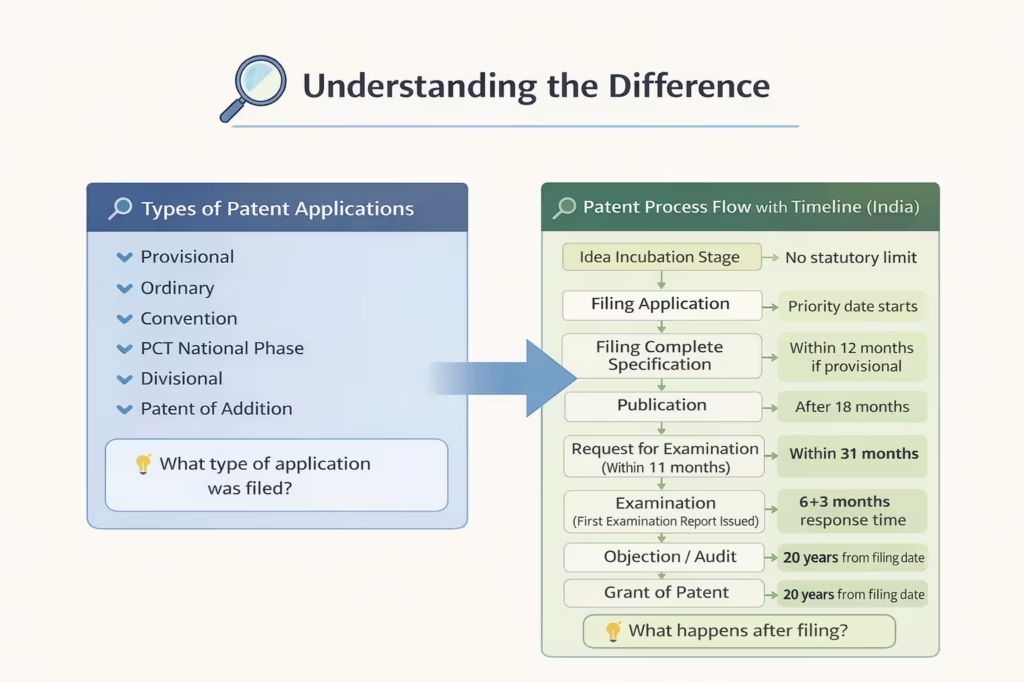
Apart from product and process patents, applications are classified as follows.| S. No. | Type of Application | Meaning / Purpose |
|---|---|---|
| 1️⃣ | Provisional Application | Filed to secure an early priority date when invention is not fully completed. Complete specification must be filed within 12 months. |
| 2️⃣ | Ordinary (Non-Provisional) Application | Direct application filed in India without claiming any foreign priority. |
| 3️⃣ | Convention Application | Filed in India claiming priority from a convention country within 12 months of first filing. |
| 4️⃣ | PCT National Phase Application | Application entering India from an international PCT application. |
| 5️⃣ | Divisional Application | Filed when original application contains more than one invention. |
| 6️⃣ | Patent of Addition | Filed for improvement or modification of an already filed/granted invention. |
India Patent Office (Patent Office in India)
| Office | Territorial Jurisdiction |
| Patent Office Branch, Mumbai | The States of Maharashtra, Gujarat, Madhya Pradesh, Goa and Chhattisgarh and the Union Territories of Daman and Diu & Dadra and Nagar Haveli |
| Patent Office Branch, Chennai | The States of Andhra Pradesh, Karnataka, Kerala, Tamil Nadu, Telangana and the Union Territories of Pondicherry and Lakshadweep |
| Patent Office Branch, New Delhi | The States of Haryana, Himachal Pradesh, Punjab, Rajasthan, Uttar Pradesh, Utarakhand, Delhi and the Union Territory of Chandigarh, Jammu and Kashmir and Ladakh. |
| Patent Office, Kolkata (HQ) | The rest of India. |
How a Patent is Granted?
Obtaining a patent involves several steps. While the details differ by country, the basic stages are similar.
1. Research & Evaluation
Before filing, an inventor must ensure that the invention is novel. This is done by:
-
Patent searches
-
Prior-art analysis
-
Professional consultation
2. Drafting the Patent Application
This is a crucial step. A well-drafted patent application includes:
-
Specification
-
Claims
-
Drawings
-
Abstract
Claims are especially important because they define the legal boundaries of protection.
3. Filing the Application
The application is filed with the national patent office (e.g., Indian Patent Office in India).
4. Publication
Patent applications are usually published after 18 months unless an early publication request is filed.
5. Examination
An examiner reviews the application to ensure it meets all legal criteria. This step may involve objections and responses from both sides.
6. Grant of Patent
Once all objections are resolved, the patent is granted. In India, a patent is valid for 20 years from the filing date.
🎥 Watch: Complete Patent Registration Process in India (Step-by-Step Guide) Once you understand what a patent is, the next important step is to learn how to register it. This video explains the entire patent registration process in India, from filing the application to the final grant, in a clear step-by-step manner.
📑 Patent Filing Process in India – Complete Step-by-Step Guide
Learn the complete Patent Filing Process in India under the Patents Act, 1970. This video explains the different types of patent applications, mandatory patent forms, official government fees, filing procedure, examination process, publication, and other essential concepts in a simple and easy-to-understand manner.
▶ Watch Complete Patent Filing GuidePatent Timeline in India
| Stage | Process | Time Limit / Timeline |
|---|---|---|
| 1️⃣ | Idea / Invention Stage | No statutory limit |
| 2️⃣ | Filing of Application (Provisional / Complete) | Priority date fixed on filing |
| 3️⃣ | Filing Complete Specification (if provisional filed) | Within 12 months from provisional filing date |
| 4️⃣ | Publication of Application | Automatically after 18 months from priority date |
| 5️⃣ | Early Publication (Optional) | Can request anytime; published within ~1 month of request |
| 6️⃣ | Request for Examination (RFE) | Must be filed within 31 months from priority date |
| 7️⃣ | First Examination Report (FER) Issued | After RFE, no fixed statutory time (depends on workload) |
| 8️⃣ | Response to FER | Within 6 months (extendable by 3 months) |
| 9️⃣ | Hearing (if required) | If objections persist |
| 🔟 | Grant of Patent | If all objections resolved |
| ⏳ | Patent Term | 20 years from filing date (International filing date in PCT cases) |
Difference Between Patent Application & Patent Process
Patent Rights (Section 48)
What Rights Does a Patent Give?
As Per the Patents Act, 1970, Section 48- The patent protection provided by the law states that the invention cannot be commercially made, used, distributed, imported, or sold by others without the patent owner’s consent. The patent owner may permit other parties to use the invention on mutually agreed terms. As a matter of fact, the patent rights are negative rights as the owner is restricting others from using the patent in any manner without his prior permission. The patent holder may choose to sue the infringing party to stop illegal use of the patent and also ask for compensation for the unauthorized use.
A patent grants the inventor the exclusive right to:
-
Make the invention
-
Use the invention
-
Sell or license the invention
-
Prevent others from doing the same without permission
What Are the Limitations?
-
A patent is territorial (valid only in the country where it is granted).
-
It lasts only for 20 years.
-
It must be renewed annually to stay valid.
-
After expiry, the invention enters the public domain.
Patent Licensing and Monetization
Patents are not just about protection—they can also help monetization.
An inventor can:
-
License the patent to a company
-
Sell the patent outright
-
Create a startup around the invention
-
Collaborate with industry partners for development
Licensing generates royalties, while selling provides immediate revenue.
Patent Validity
In India, as per the Patents Act, 1970, Section 53, the validity of a patent is 20 years from the date of filing of the patent application. This 20-year term applies to all types of patents, including ordinary, convention, and PCT national phase applications, and is calculated from the filing date (or international filing date in case of PCT applications). During this period, the patent holder enjoys exclusive rights to make, use, sell, or license the invention, subject to payment of prescribed annual renewal fees. Once the 20-year term expires, the invention falls into the public domain and can be freely used by anyone without requiring permission from the patent owner.Patent Renewal
The legal basis for renewal is provided under Section 53 of the Patents Act, 1970, which states that a patent shall cease to have effect if the prescribed renewal fee is not paid within the stipulated time. Renewal fees are payable every year starting from the third year onwards and must be paid to keep the patent in force until the completion of the 20-year term. The exact fee amounts are prescribed under the First Schedule of the Patents Rules, 2003 and vary depending on the category of applicant (natural person, startup, small entity, or others)Why Understanding What is a Patent is Important?
In the age of AI, biotechnology, robotics, and renewable energy, patents are more important than ever. They:
-
Encourage entrepreneurs
-
Fuel technological progress
-
Build trust between creators and investors
-
Protect inventors from unfair competition
-
Promote a culture of innovation
For students, researchers, startups, and businesses, understanding patents is essential for participating in today’s global knowledge economy.
A patent is much more than a legal right—it is a powerful tool that protects creativity, encourages innovation, and drives economic growth. Whether you’re an inventor, a startup founder, a student, or simply someone curious about IPR, understanding patents is the first step towards safeguarding your ideas and turning them into valuable assets. Innovation is the future, and patents are the shield that protects it.
Important Links
Follow IPR Guru on Social Media
| ▶ YouTube | ✖ Twitter (X) | |
| 📢 Telegram |
FAQs
What is a patent under Indian law?
What are the essential requirements for patentability?
What is the term of a patent in India?
What is the difference between a patent and copyright?
Can all inventions be patented?
Can a patent be transferred or licensed?
Is patent protection territorial?
🎓 Join IPR Guru Academy
Register now to receive structured preparation for Patent Agent, Patent Examiner, Trademark Agent, and CGPDTM Exams, along with exclusive study resources, exam updates, and priority access to upcoming courses.
Register Now