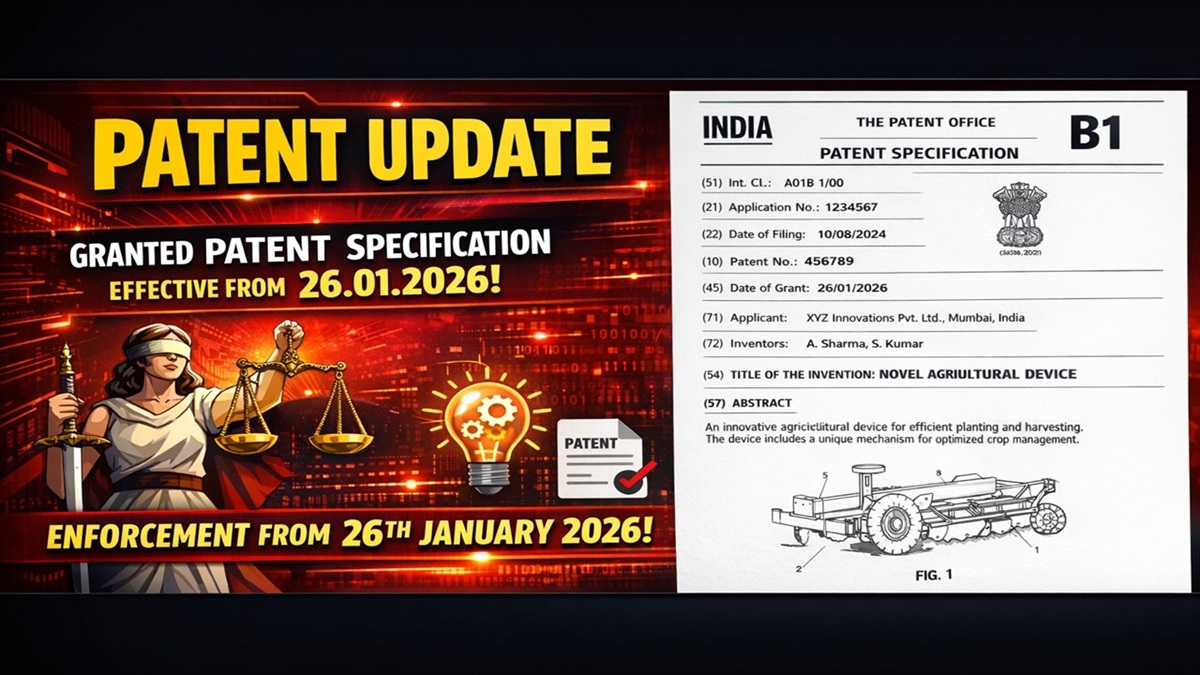
B1 Patent Specification India marks a significant reform in the Indian patent publication framework effective from 26 January 2026. The Office of the Controller General of Patents, Designs and Trade Marks (O/o CGPDTM) has officially announced that all patents granted on or after this date will be published in the new B1 format.
This update, widely referred to as the B1 Patent India 2026 reform, introduces a standardized granted patent format aligned with global patent publication standards. The change improves clarity, international compatibility, and enforcement transparency for Indian patents.
Overall, the introduction of the B1 Patent Specification India 2026 reform enhances enforcement clarity, improves due diligence processes, and increases global confidence & recognition in Indian patents. IP India website published notice on 31st January 2026, Stating that- “The Office of the Controller General of Patents, Designs and Trade Marks (O/o CGPDTM) hereby informs all stakeholders that granted patent specification is being implemented with effect from 26.01.2026. An example of the first page of B1 specification is enclosed here.”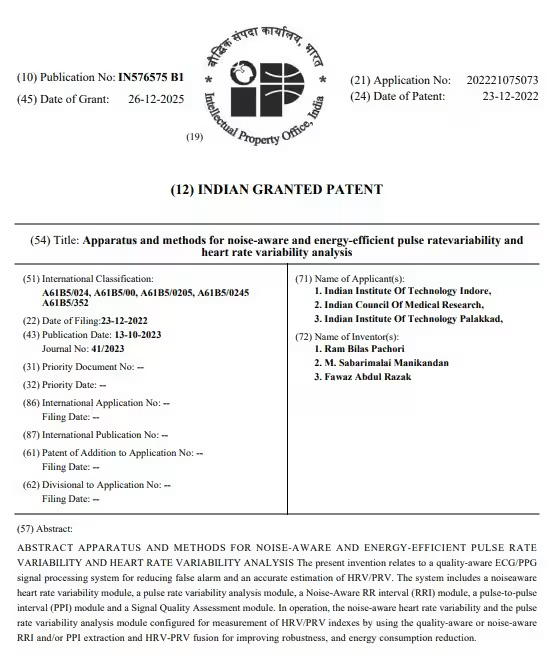
B1 Patent Specification India 2026: Major Reform in Indian Patent
What is B1 Patent Specification India?
B1 Patent Specification India refers to the final, legally enforceable granted patent document issued after successful examination and grant of a patent application.
A granted patent specification includes:
-
Publication Number
-
Date of Grant
-
Application Number
-
Date of Patent
-
Applicant Name
-
Inventor Name
-
International Classification
-
Date of Filing
-
Publication Date
- Journal No
This document determines the legal scope of protection for the invention and serves as an official public record.

Meaning of B1 in B1 Patent India
In patent terminology, “B1” is an internationally recognized kind code used to indicate a granted patent specification.
The B1 Kind Code Confirms:
-
The patent has completed publication stage.
-
The patent is officially granted.
-
The patent is legally enforceable.
Major countries’ patent offices such as the United States Patent and Trademark Office, European Patent Office, Japan Patent Office, China Patent Office and World Intellectual Property Organization follow standardized kind code systems. With the implementation of the B1 Patent Specification, India now aligns more closely with global intellectual property practices.
Official Announcement on B1 Patent Specification India 2026
The Indian Patent Office has clarified that:
-
The Indian Granted B1 Patent Specification format will be implemented from 26 January 2026.
-
This B1 specification update applies to all patents granted on or after 26 January 2026.
-
Patents granted before this date will not be reissued in B1 format unless specifically notified.
Importantly, this reform affects only the publication format and does not alter the patent examination process or legal requirements.
First Page Structure of B1 Patent Specification India
According to the sample format provided, the first page of a B1 Patent Specification India document will contain:
-
Publication Number (e.g., IN576575 B1)
-
Date of Grant
-
Application Number
-
Date of Filing
-
Title of the Invention
-
International Patent Classification (IPC)
-
Applicant(s) Name
-
Inventor(s) Name
-
Journal No
This structured and standardized layout enhances readability, authenticity, and professional presentation of granted patents.
Why Has the B1 Patent India Format Been Introduced?
The implementation of the B1 Patent Specification India 2026 reform serves multiple objectives.
1. International Harmonization
Most European countries, along with Japan, China, and the United States, had already adopted the B1 patent specification format for granted patents. In contrast, India had not implemented a clearly distinguished B1 publication system, which created certain limitations in enforcement clarity and international comparability. As global patent systems increasingly emphasized structured documentation and transparency, India’s absence of a B1 format placed it at a relative disadvantage in the international patent landscape. Therefore, the introduction of the B1 Patent Specification reform became essential to harmonize Indian patent practice with established global standards and strengthen its position in international markets.
2. Clear Identification of Granted Patents
The B1 code immediately signals that the patent is granted and enforceable, eliminating confusion with published applications.
3. Improved Legal Certainty
A standardized granted patent document improves:
-
Enforcement clarity
-
Due diligence during licensing and acquisitions
-
Patent searches and analytics
-
IP valuation processes
4. Increased Transparency and Trust
The structured B1 Patent Specification enhances credibility and strengthens India’s intellectual property ecosystem.
Therefore, the introduction of the B1 Patent Specification India was a necessary reform to align Indian patent practice with global standards, enhance legal certainty, and strengthen international confidence in Indian patents.
Impact of B1 Patent Specification India on Stakeholders
For Patent Holders
-
Clear proof of grant status
-
Stronger presentation before investors
-
Improved enforcement documentation
For Patent Agents and Attorneys
-
Uniform granted patent documents
-
Simplified referencing in litigation
-
Professional alignment with global standards
For Startups and Corporates
-
Easier IP audits
-
Better valuation during fundraising
-
Enhanced global acceptance of Indian patents
For Researchers and Students
-
Improved readability
-
Better understanding of patent structure
-
Easier academic referencing
Does B1 Patent Specification India Change the Grant Procedure?
No.
The implementation of the B1 Patent Specification India does not change:
-
Patent examination procedures
-
Grant timelines
-
Substantive legal requirements
-
Opposition mechanisms
It is purely a publication and documentation enhancement.
Is Any Action Required from Applicants?
Currently:
-
No additional forms are required.
-
No additional fees are payable.
-
The update will automatically apply to patents granted on or after 26 January 2026.
Applicants should simply note that their granted patent document will appear in the new B1 Patent India format.
How B1 Patent Specification India Strengthens Enforcement
The B1 format enhances enforcement by:
-
Clearly indicating grant status on the first page
-
Reducing ambiguity in infringement disputes
-
Improving evidentiary clarity in court proceedings
-
Strengthening recognition of patent rights
For litigation-focused environments, this clarity is highly beneficial.
What is B1 Patent India Kind Codes?
These codes are governed by WIPO Standard ST.16 and are widely adopted across major patent jurisdictions. The most common kind codes include A, A1, A2, B1, and B2, each indicating a different stage such as application publication, examined application, or granted patent.
In general practice, “A” series codes are used for patent applications. For example, A1 typically indicates a published patent application with a search report, while A2 may indicate publication without a search report. The “B” series codes are used for granted patents. B1 commonly represents a granted patent without post-grant amendment publication, whereas B2 may indicate a granted patent published after amendments. The introduction of the B1 Patent Specification India format from 26 January 2026 aligns India with this globally recognized classification system.
Countries such as the United States, European Patent Office member states, Japan, China, and publications under WIPO have long used structured kind codes to clearly distinguish applications from granted patents. By adopting the B1 Patent Specification, India joins established patent systems that prioritize transparency, enforcement clarity, and international harmonization.
Common Patent Kind Codes and Their Meaning
| Kind Code | Meaning | Stage of Patent | Commonly Used In |
|---|---|---|---|
| A | Patent Application Publication | Pre-grant stage | Multiple jurisdictions |
| A1 | Published application (with search report) | Pre-grant | US, Japan, China, European Patent Office |
| A2 | Published application (without search report) | Pre-grant | EP (in certain cases) |
| B1 | Granted patent (standard grant publication) | Post-grant | US, Japan, China, European Patent Office, now India |
| B2 | Granted patent (with amendments or reissue) | Post-grant | US, European Patent Office |
What is a Kind Code in Patent Documents?
A Kind Code is a letter (often followed by a number) printed on a patent document to identify the legal status and publication type of the patent document.
For example:
-
IN 576575 B1
-
US 3451278 B1
-
WO 2026/981234 A1
-
EP 567123 B1
The kind code tells you:
-
Whether the document is a patent application or a granted patent
-
Whether it is the first publication or a corrected publication
-
Whether a search report is included
-
Whether the patent was amended or re-examined
Kind codes are standardized internationally under WIPO Standard ST.16.
What is WIPO Standard ST.16?
WIPO Standard ST.16 is an international coding system developed by the World Intellectual Property Organization (WIPO). It provides a framework for identifying different types of patent documents across countries. Under ST.16, patent documents are broadly classified into three major series:
A-Series – Patent Applications
These codes are used for patent application publications.
Examples:
-
A1
-
A2
-
A3
These generally indicate different stages of publication of an application.
B-Series – Granted Patents
These codes are used after a patent is granted.
Examples:
-
B1
-
B2
The difference between B1 and B2 depends on whether the application was previously published or amended.
C-Series – Amended or Re-examined Patents
These codes are used for patents that have undergone re-examination, limitation, or correction after grant. Not all patent offices actively use C-series codes, but the classification exists under the standard.
Why Do PCT (WIPO) Documents Only Show A-Series Codes?
Under the Patent Cooperation Treaty (PCT) system:
-
International applications are published as WO documents, Where “WO” stands for “World Intellectual Property Organization”.
-
No patent is granted at the international stage.
-
The PCT system only facilitates international filing and search.
-
Actual grant happens later in national or regional phases.
👉 Only A-series codes are used (A1, A2, A3), Because no grant occurs during the PCT stage:
👉 B1 or B2 kind codes do NOT appear in WO (WIPO) publications.
For example:
-
WO 2026/347291 A1
-
WO 2026/312498 A2
This means it is a PCT international publication. No grant occurs during the PCT stage.
What Does “WO” Mean?
When a patent application is filed under the PCT system, it is published as a WO document.
-
WO stands for World Intellectual Property Organization.
-
It indicates that the document is an international publication, not a national patent.
Example:
-
WO 2026/863401 A1
This means it is a PCT international publication. No grant occurs during the PCT stage.
Kind Codes For Different Countries
Although all major patent offices follow WIPO ST.16 principles, implementation varies.
For example:
India
-
A1 → Application publication
-
B1 → Granted patent (no prior publication) (Effective From 26.01.2026)
United States
-
A1 → Application publication
-
B1 → Granted patent (no prior publication)
-
B2 → Granted patent (after prior publication)
Japan
-
A → Application publication
-
B1/B2 → Granted patents
Europe
-
A1, A2, A3 → Different stages of application publication
-
B1 → Granted patent
So the number of visible “types” may differ across jurisdictions, but the underlying structure still follows ST.16.
B1 Patent India Summary
✔ Kind Code tells the legal perspective of any patent document.
✔ WIPO ST.16 provides the global framework and Kind codes. WIPO Standard ST.16 is an international coding system.
✔ A-Series = Application publications.
✔ B-Series = Granted patents.
✔ C-Series = Post-grant amended/re-examined patents.
✔ PCT (WO) publications never show B1/B2 because no grant happens at the international stage.
✔ National (India Patent office, US Patent Office, Japan Patent Office, European Patent System, China Patent Office) and regional offices issue B-series codes because they grant patents.
Future Outlook of B1 Patent Specification India
The introduction of the B1 Patent Specification India 2026 reform indicates that the Indian Patent Office is moving toward:
-
Digitization
-
Global compatibility
-
Stronger enforcement infrastructure
-
Enhanced transparency
This reform also boosts confidence among foreign applicants filing patents in India.
The implementation of B1 Patent Specification India from 26 January 2026 represents a major structural improvement in India’s patent publication system. By adopting a standardized and internationally recognized format, the Indian Patent Office has enhanced transparency, legal certainty, and global credibility of Indian patents.
Patent professionals, businesses, and innovators should view this reform as a positive step toward strengthening India’s intellectual property framework.
B1 Patent Specification Sample: Download PDF
Important Links
Follow IPR Guru on Social Media
| ▶ YouTube | ✖ Twitter (X) | |
| 📢 Telegram |