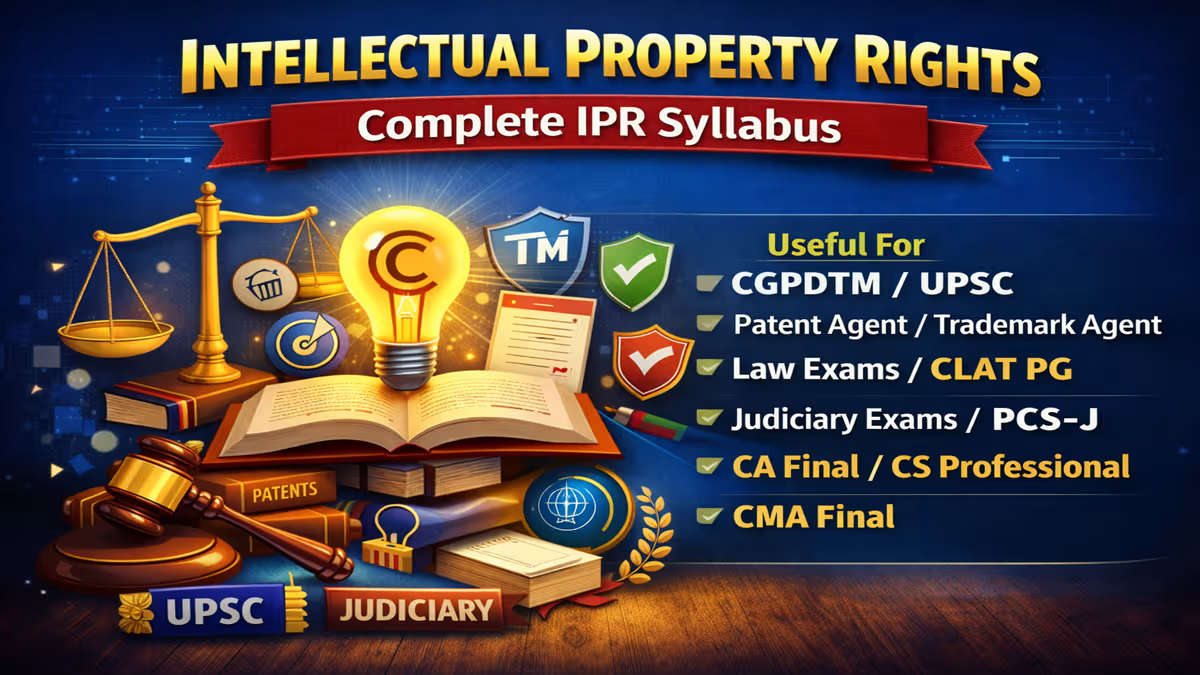
Intellectual Property Rights (IPR) has become one of the most important academic and competitive exam subjects in India. With innovation, startups, research, and technology growing rapidly, understanding IPR is no longer optional—it is essential. For students preparing for LLB, LLM, BBA, MBA, BTech, MTech, CSIR-NET, UGC-NET, Judiciary, Patent Agent Examination, and university semester exams, the Intellectual Property Rights Syllabus PDF 2026 plays a crucial role in structured preparation. This article provides a detailed, updated, and exam-oriented overview of the IPR syllabus for 2026, covering all major IPR laws such as Patents, Copyright, Trademarks, Geographical Indications, Trade Secrets, and Semiconductor Integrated Circuits Layout Design (SICLD). If you are searching for a reliable IPR syllabus in PDF format for 2026, this guide will help you understand what to study, how to prepare, and how to score full marks.
If you are preparing for IPR exams or want to strengthen your understanding of intellectual property, knowing the IPR syllabus is the first step. The IPR syllabus 2026 covers all essential topics in Intellectual Property Rights including patents, trademarks, copyright, designs, and geographical indications.
For your convenience, you can also access the IPR syllabus PDF download at the end of this post. Whether you are a law student, a professional, or an aspirant for competitive exams, this IPR exam syllabus guide will help you structure your study plan efficiently.
Welcome to your definitive IPR Syllabus 2026 guide — an in‑depth and up‑to‑date overview of the Intellectual Property Rights syllabus. This page breaks down all topics, provides downloadable IPR syllabus PDF, and helps you understand what subjects you need to master for IPR exams and certification.
IPR Syllabus PDF 2026 Important Topics
Introduction & Origin of Intellectual Property
The concept of Intellectual Property originated from the need to protect human creativity and innovation. Historically, societies recognized moral and economic rights of creators. In India, IPR evolved under colonial laws and later aligned with international conventions. The first patent related legislation in India was Act VI of 1856, adapted from the British Patent Law of 1852. The new Act was rechristened as ―The Patterns and Designs Protection Act, under Act XIII of 1872. This Act was further amended in 1883 (XVI of 1883) to include the provision of protection for Novelty‘ in the invention. At the beginning of the 20th century, all the earlier Acts related to inventions and designs were done away with the introduction of “The Indian Patents and Designs Act, 1911” (Act II of 1911). Key Acts & Laws:- Statute of Monopolies, 1623
- Statute of Anne, 1710
- British Patent Law, 1852
- The Patents & Design Act, 1872
- British Patents & Design Act, 1907
- Indian Patents and Designs Act, 1911
- Imperial Copyright Act, 1911
- Trademarks Act, 1938 (UK),
- Trade Marks Act, 1940
- Trade and Merchandise Marks Act, 1958
- TRIPS Agreement, 1995 (WTO)
- Meaning and nature of Intellectual Property
- Evolution of IP laws
- Origin of Intellectual Property in India
- Need and importance of IPR
- Types of Intellectual Property

Patents
A patent is a statutory right granted for an invention that is new, involves an inventive step, and is capable of industrial application. Patents encourage technological innovation by granting exclusive rights for a limited period. Governing Act:- The Patents Act, 1970
- Patents Rules, 2003 (as amended)
- Meaning of Patent, Definition
- Patent Eligibility Criteria
- What is a patent
- Patentable and non-patentable inventions
- Novelty, inventive step, and industrial applicability
- Patent application process
- Examination, opposition, and grant of patent
- Rights and obligations of patentee
- Term of Patent
- Compulsory licensing
- Patent infringement and remedies

Copyright
Copyright protects original literary, artistic, musical, dramatic works, cinematograph films, and sound recordings. It safeguards the expression of ideas, not ideas themselves. Governing Act:- Copyright Act, 1957
- Copyright Rules, 2013
- Meaning and scope of copyright
- Ownership and authorship
- Term of copyright
- Economic and moral rights
- Fair dealing
- Copyright registration
- Infringement and remedies

Trademarks
A trademark is a sign capable of distinguishing goods or services of one person from another. It plays a vital role in brand identity and consumer protection. Governing Act:- Trade Marks Act, 1999
- Trade Marks Rules, 2017
- Definition and types of trademarks
- Registration procedure
- Absolute and relative grounds for refusal
- Well-known trademarks
- Trademark registration
- Assignment and licensing
- Infringement and passing off

Geographical Indications (GI)
Geographical Indications protect products that have a specific geographical origin and possess qualities or reputation due to that origin. Governing Act:- Geographical Indications of Goods (Registration and Protection) Act, 1999
- Meaning and features of GI
- Registration process
- Authorized users
- Rights conferred
- GI registration
- GI infringement
- Indian GI examples

Trade Secrets
Trade secrets include confidential business information that provides a competitive edge. Unlike other IP rights, trade secrets are protected without registration. Legal Framework:- Indian Contract Act, 1872
- Common law principles
- Meaning of trade secrets
- Protection through contracts
- Confidentiality agreements
- Remedies for breach

Semiconductor Integrated Circuits Layout Designs (SICLD)
Layout designs protect the three-dimensional configuration of semiconductor integrated circuits. Governing Act:- Semiconductor Integrated Circuits Layout-Design Act, 2000
- Meaning of layout design
- Registration procedure
- Rights of registered proprietor
- Infringement and penalties
Plant Varieties & Farmers’ Rights
This system protects plant breeders while recognizing farmers’ rights. Governing Act:- Protection of Plant Varieties and Farmers’ Rights Act, 2001
- Registrable plant varieties
- Breeders’ rights
- Farmers’ rights
- Benefit sharing
Traditional Knowledge
Traditional knowledge includes indigenous practices, medicines, and cultural expressions. Legal Framework:- Traditional Knowledge Digital Library (TKDL)
- Patent Act, 1970 (defensive protection)
- Meaning and importance
- Misappropriation issues
- Protection mechanisms

Industrial Designs
Industrial designs protect the aesthetic aspects of articles. Governing Act:- Designs Act, 2000
- Features of design protection
- Registration process
- Rights and term
- Piracy of designs

Biodiversity Conservation
Biodiversity laws ensure conservation and sustainable use of biological resources. Governing Act:- Biological Diversity Act, 2002
- Access and benefit sharing
- National Biodiversity Authority
- Bio-piracy
WTO & TRIPS Agreement
The WTO administers international trade rules, including IP protection through TRIPS. Key Agreement:- TRIPS Agreement, 1995
- Minimum standards of IP protection
- Enforcement mechanisms
- TRIPS and developing countries
WIPO & International Treaties
WIPO administers international IP treaties. Important Treaties:- Paris Convention
- Berne Convention
- PCT
- Madrid Protocol
- Hague Agreement
National IPR Policy, 2016
India’s National IPR Policy aims to promote innovation and awareness. Key Features:- Awareness and education
- Strong legal framework
- Commercialization of IP
Important Cases & Judgements
Landmark judgments shape the interpretation of IP laws. Examples:- Novartis v. Union of India (Patent law)
- Cadila Healthcare v. Cadila Pharmaceuticals (Trademark)
- Eastern Book Company v. D.B. Modak (Copyright)
What is IPR Syllabus?
IPR syllabus refers to the structured list of topics that define what you need to study under Intellectual Property Rights (IPR). It includes key areas such as patents, trademarks, copyright, designs, GI, and more.
Watch this video on IPR Syllabus 2026 👇👇

Detailed IPR Syllabus (Summary)
- Introduction & Origin of IP
- Patent Law – The Patents Act, 1970
- Copyright Law – Copyright Act, 1957
- Trademark Law – Trade Marks Act, 1999
- Geographical Indications – GI Act, 1999
- Trade Secrets
- SICLD – SIC Layout Design Act, 2000
- Plant Varieties & Farmers’ Rights Act, 2001
- Traditional Knowledge
- Industrial Designs – Designs Act, 2000
- Biodiversity – Biological Diversity Act, 2002
- WTO & TRIPS Agreement
- WIPO & International Treaties
- National IPR Policy, 2016
- Important Case Laws
Exam Relevance – Who Should Study This IPR Syllabus?
This Complete Intellectual Property Rights (IPR) Syllabus is carefully designed to meet the requirements of multiple competitive, professional, and legal examinations. Each topic is explained with relevant Acts, Rules, Policies, and Case Laws, making it highly exam-oriented.
This syllabus is extremely useful for:
-
CGPDTM Exams – Patent Examiner, Patent Agent & Trademark Agent
-
UPSC – Trademark Examiner, Prelims (IPR & WTO related questions) and Mains (GS Paper II & III)
-
Law Exams & LLM Entrance – Conceptual clarity + case laws
-
CLAT PG – IPR static syllabus with current relevance
-
Judiciary Exams & PCS-J – Bare Act based preparation with landmark judgments
-
CA Final – Economic Laws & IPR-related legal framework
-
CS Professional – IPR, Corporate Laws, and International Treaties
-
CMA Final – Business Laws, WTO–TRIPS, and IPR policy framework
- Any other IPR Exams
Why this syllabus is exam-scoring?
-
Covers 100% static IPR syllabus
-
Includes all major Indian IPR Acts
-
Integrates international treaties (WIPO, WTO–TRIPS)
-
Focuses on frequently asked MCQs, case laws & concepts
-
Suitable for objective + descriptive exams
Important Links
Follow IPR Guru on Social Media
| ▶ YouTube | ✖ Twitter (X) | |
| 📢 Telegram |
Download IPR Syllabus PDF
You can get the complete IPR syllabus PDF download here for easy reference and structured preparation: Download IPR Syllabus PDF 2026
Having the PDF handy helps you revise topics systematically and focus on areas important for exams.