Join our Official Telegram Channel to receive instant notifications, PDF notes, important announcements, and free study resources. Join Telegram →
Understanding the Trademark Agent Exam Pattern 2027 is one of the most crucial steps for aspirants who want to build a successful career in Intellectual Property Rights (IPR). Many candidates focus only on studying the Trade Marks Act, but without knowing the exact exam structure, marking scheme, and paper pattern, preparation remains incomplete. The Trademark Agent Examination is conducted under the Office of the Controller General of Patents, Designs & Trade Marks (CGPDTM), Government of India. The exam is designed to test both legal knowledge and practical application skills, ensuring that only competent candidates are registered as Trademark Agents.
To succeed in the examination, it is essential for candidates to align their preparation with the actual structure of the exam. The pattern is carefully designed to assess not just theoretical understanding but also the ability to apply legal provisions in practical scenarios. This means that simply memorizing sections of the Trade Marks Act, 1999 is not enough—candidates must also develop strong analytical and drafting skills.
📝 Understanding the Trademark Agent Exam Pattern is essential for effective preparation.
🎯 Knowing the structure, question types, and marking scheme helps you plan your strategy better.
Trademark Agent Exam Pattern Explained:
🎥 Watch this video to get a clear breakdown of the exam pattern, sections, and scoring approach.
🚀 This video is highly useful for Trademark Agent Exam 2027 aspirants.
🔥 Learn how to approach the exam smartly and maximize your score.
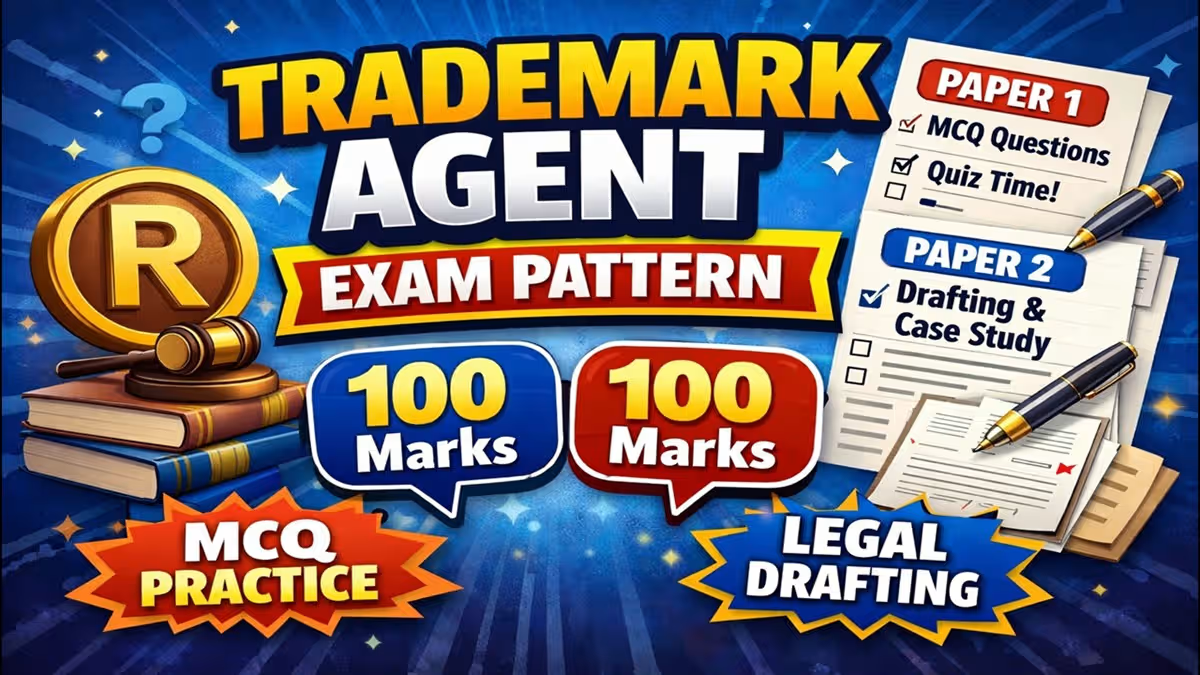
Another important aspect of the Trademark Agent Exam is its balanced approach between law and practice. While Paper I focuses on conceptual clarity and statutory interpretation, Paper II emphasizes real-world application through drafting, objection replies, and case-based questions. This combination ensures that candidates are well-equipped to handle professional responsibilities after qualifying the exam.
📘 Check Trademark Agent Syllabus First
Before starting preparation for the Trademark Agent Exam, go through the official syllabus guide to understand the complete exam structure and important topics.
Moreover, the inclusion of the Viva Voce (interview) stage makes this examination unique compared to many other competitive exams. It evaluates a candidate’s communication skills, legal reasoning, and practical understanding of trademark procedures. Candidates who prepare only for written papers often struggle at this stage, highlighting the importance of holistic preparation.
This article provides a detailed breakdown of the exam pattern, marking scheme, paper-wise structure, and preparation strategy, making it extremely useful for aspirants preparing for CGPDTM, Trademark Agent, and other exams.
Trademark Agent Exam Pattern 2027: Easy Guide
Trademark Agent Exam Pattern 2027 – Overview
| Particulars | Details |
|---|---|
| Conducting Authority | CGPDTM (Government of India) |
| Exam Mode | Offline (Written) + Interview |
| Total Stages | 3 Stages |
| Papers | Paper I + Paper II + Viva |
| Total Marks | 250 Marks |
| Duration | 3 Hours per Paper |
| Type of Questions | Objective + Descriptive |
👉 The exam pattern is designed to evaluate both theoretical understanding and practical drafting skills, similar to other IPR examinations.
Trademark Agent Exam Pattern 2027 – Selection Process
The Trademark Agent Exam consists of three stages:
1. Paper I – Trademark Law & Practice
2. Paper II – Drafting & Interpretation
3. Viva Voce (Interview)
Each stage plays an important role in final selection.
Paper I – Trademark Act & Rules (100 Marks)
Objective of Paper I
Paper I tests your theoretical knowledge of trademark law in India.
Key Subjects Covered
- Trade Marks Act, 1999
- Trade Marks Rules, 2017
- Definitions & concepts
- Types of trademarks
- Trademark registration process
- Opposition & rectification
- Infringement & passing off
- International trademark systems (Madrid Protocol basics)
Exam Pattern (Paper I)
| Part | Section | No. of Questions | Marks per Question | Total Marks |
| Part A | Objective (MCQ) | 100 | 1 mark | 100 |
Important Topics
- Absolute & Relative Grounds (Section 9 & 11)
- Trademark Classification (Nice Classification)
- Well-known trademarks
- Assignment & Licensing
- Rectification & Cancellation
- Infringement vs Passing Off
👉 Tip: Focus on bare act + previous year questions. Most questions are concept-based.
Paper II – Drafting & Interpretation (100 Marks)
This is the most important and scoring paper in the Trademark Agent Exam.
Objective of Paper II
To test practical skills and real-world application of trademark law.
Exam Pattern (Paper II)
| Part | Section | No. of Questions | Marks per Question | Total Marks |
| Part A | Descriptive / Theory / Legal Explanation | 4 | 10 marks | 40 |
| Part B | Practical / Drafting / Case-based | 5 | 10 marks | 50 |
| Part C | Advanced Drafting / Legal Application | 1 | 10 marks | 10 |
Sections Included
- Trademark Application Drafting
- Reply to Examination Report (Objection Reply)
- Case Study Based Questions
- Legal Interpretation
Important Areas
- Drafting TM Application (Form TM-A basics)
- Reply to objections under Section 9 & 11
- Writing legal arguments
- Identifying distinctiveness
- Practical scenarios in trademark disputes
👉 Tip: Practice drafting daily. This paper decides your selection.
Viva Voce (Interview) – 50 Marks
After qualifying both written papers, candidates appear for the interview.
What is Tested?
- Practical knowledge of trademark law
- Communication skills
- Drafting clarity
- Problem-solving ability
Key Areas
- Real-life trademark scenarios
- Legal interpretation
- Professional ethics
- Application-based questions
Important Insight
The viva focuses more on understanding and application rather than rote learning, similar to other IPR exams where practical competence is crucial.
Trademark Agent Exam Marking Scheme
| Stage | Marks |
|---|---|
| Paper I | 100 |
| Paper II | 100 |
| Viva Voce | 50 |
| Total | 250 Marks |
Minimum Qualifying Marks (Expected)
- Minimum marks required in each paper (50%)
- Must qualify written exam to appear in Viva
- Final merit based on overall performance (Aggregate 60% Required)
Key Features of Trademark Agent Exam Pattern
Balanced Exam Structure
Focus on both law + practical drafting
No Negative Marking
Helps candidates attempt maximum questions
Drafting is Key
Paper II plays a decisive role
Interview Matters
Viva can significantly impact final ranking
Paper I vs Paper II – Which is Tough?
| Parameter | Paper I | Paper II |
|---|---|---|
| Nature | Theory | Practical |
| Difficulty | Moderate | High |
| Scoring | High | Moderate, High (if practiced) |
| Importance | Most Important | Most Important |
👉 Conclusion: Paper II is tougher as compare to paper I.
Preparation Strategy Based on Exam Pattern
Start with Bare Act
Read the Trade Marks Act line-by-line.
Focus on PYQs
Understand exam trend and question pattern.
Master Drafting Skills
Practice:
- TM Application
- Objection replies
- Case-based answers
Make Short Notes
Section-wise revision notes help in quick revision.
Mock Tests & Practice
Simulate real exam conditions.
Prepare for Viva Early
Don’t wait till the result—start early.
Common Mistakes to Avoid
- Ignoring drafting practice
- Only memorizing sections
- Not solving previous year papers
- Underestimating viva
- Lack of conceptual clarity
3-Month Study Plan
Month 1:
- Complete Trade Marks Act
- Basic concepts + notes
Month 2:
- Start drafting practice
- Solve PYQs
Month 3:
- Full mock tests
- Revise + prepare for viva
Therefore, a smart preparation strategy should involve a mix of bare act reading, previous year question analysis, drafting practice, and mock interviews. By understanding the exam pattern thoroughly and preparing accordingly, candidates can significantly improve their chances of success and build a strong foundation for a career in Intellectual Property Rights. The Trademark Agent Exam Pattern 2027 is designed to test whether a candidate can actually work as a Trademark Agent—not just whether they can memorize the law.
If you align your preparation with:
- Bare Act understanding
- Drafting practice
- Concept clarity
- Mock tests
you can significantly increase your chances of success.
Trademark Agent Exam Pattern – FAQs
1. What is the exam pattern of Trademark Agent Exam 2027?
The exam consists of Paper I (Law), Paper II (Drafting), and Viva Voce, totaling 300 marks.
2. How many papers are there in the Trademark Agent Exam?
There are 2 written papers + 1 interview.
3. What is the marking scheme?
Each stage carries 100 marks, making a total of 300 marks.
4. Is there negative marking?
Generally, no negative marking is applied.
5. What is the duration of each paper?
Each paper is conducted for 3 hours.
6. Which paper is most important?
Paper II (Drafting & Interpretation) is the most important and scoring paper.
7. What is asked in Paper I?
Questions are based on the Trade Marks Act, Rules, and legal concepts.
8. What is asked in Paper II?
Drafting, case studies, and practical problem-solving questions.
9. Is viva voce compulsory?
Yes, it is the final stage and compulsory after qualifying written papers.
10. How to prepare effectively?
Focus on:
- Bare Act
- Drafting practice
- PYQs
- Mock tests
Important Links
Follow IPR Guru on Social Media
 LinkedIn LinkedIn |
 YouTube YouTube |
 Twitter (X) Twitter (X) |
 Facebook Facebook |
 Instagram Instagram |
 Telegram Telegram |
🎓 Join IPR Guru Academy
Register now to receive structured preparation for Patent Agent, Patent Examiner, Trademark Agent, and CGPDTM Exams, along with exclusive study resources, exam updates, and priority access to upcoming courses.
Register Now