
Deep Tech Startup Definition 2026: Important Changes: The Government of India has officially clarified the Deep Tech Startup Definition 2026 through a Gazette Notification issued by DPIIT. This update is crucial for founders, investors, tax professionals, patent practitioners, and competitive exam aspirants.
With India pushing innovation in AI, semiconductors, biotechnology, quantum computing, robotics, and advanced materials, the recognition framework for deep tech startup India 2026 has been clearly structured.
This article explains:
-
What is Deep Tech Startup under DPIIT 2026
-
DPIIT deep tech startup criteria
-
Turnover limit for deep tech startup 2026
-
80-IAC benefit for deep tech startup
-
Recognition and compliance implications
This guide is especially useful for CGPDTM, Patent Agent, Trademark Agent, UPSC, Law Exams, CLAT PG, Judiciary Exams, PCS-J, CA Final, CS Professional, and CMA Final aspirants.
Deep Tech Startup Definition 2026 Important Changes
What is Deep Tech Startup Definition 2026?
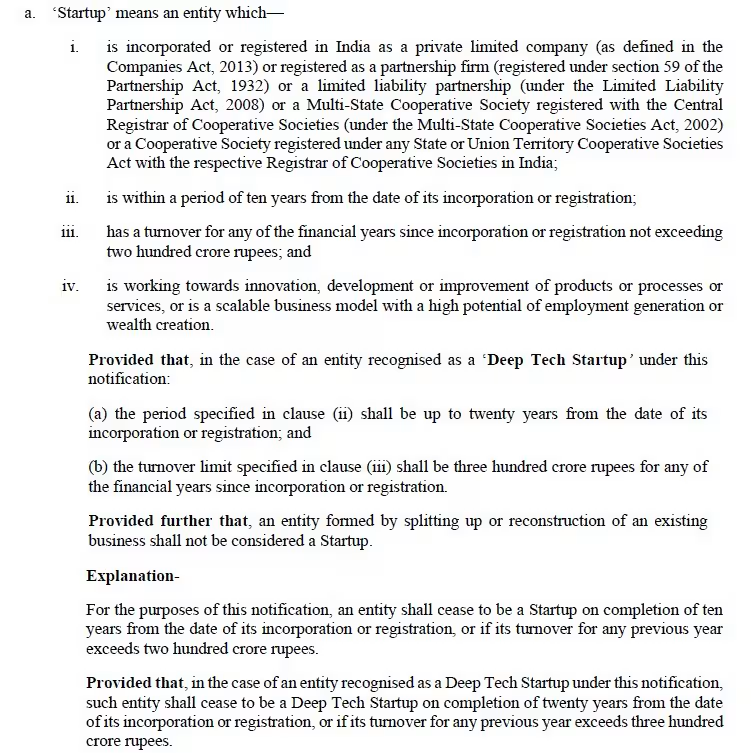
As clarified in the DPIIT Gazette Notification dated 04 February 2026, a Deep Tech Startup refers to a startup engaged in development, advancement, or commercialization of technology-based innovations rooted in scientific discovery or substantial engineering research.
Unlike regular tech startups that focus on software applications or service aggregation models, deep tech startups rely heavily on:
-
Core scientific research
-
Intellectual property creation
-
Patent-based innovation
-
Long R&D cycles
-
High technological entry barriers
The DPIIT deep tech startup definition 2026 emphasizes technology intensity and research depth rather than just digital presence.

Key Features of Deep Tech Startup India 2026
Based on the notification and policy framework, the following characteristics are essential:
1. Strong R&D Orientation
The entity must demonstrate significant research and development activities.
2. Intellectual Property Focus
Patents, design registrations, or proprietary technologies strengthen eligibility.
3. Technology-Driven Innovation
Examples include:
-
Artificial Intelligence
-
Robotics
-
Biotechnology
-
Aerospace systems
-
Semiconductor design
-
Quantum technologies
4. High Capital and Risk Profile
Deep tech startups generally require longer gestation periods before commercialization.
Also Read: 👉 New Granted Patent B1 Specification India
DPIIT Deep Tech Startup Criteria
To qualify under DPIIT recognition, the startup must satisfy general Startup India eligibility along with deep tech specialization.
Basic Startup Criteria
-
Incorporated as Private Limited Company / LLP / Registered Partnership
-
Not older than 10 years
-
Turnover limit within prescribed threshold
-
Working towards innovation, development, or improvement
Additional Deep Tech Requirement
-
Technology must be based on scientific advancement
-
Not older than 20 years
-
Substantial R&D involvement
-
Development of core technological infrastructure
-
Not merely service-based aggregation
The Gazette notification clarifies that deep tech status is not automatic — it must be demonstrable through documentation and technical disclosures.
Turnover Limit for Deep Tech Startup 2026
The turnover limit for deep tech startup 2026 remains aligned with general startup recognition norms unless specifically modified.
As per current framework:
-
Annual turnover must not exceed ₹300 crore in any financial year since incorporation.
If the turnover exceeds the prescribed limit, the entity ceases to qualify as a startup under DPIIT.
This is important for tax planning and compliance under Section 80-IAC.
80-IAC Benefit for Deep Tech Startup
One of the biggest advantages of DPIIT recognition is eligibility under Section 80-IAC of the Income Tax Act.
What is 80-IAC?
Section 80-IAC provides:
-
100% tax exemption on profits
-
For 3 consecutive years out of 10 years
-
Subject to approval from Inter-Ministerial Board (IMB)
Conditions for 80-IAC
-
Must be DPIIT-recognized startup
-
Incorporated after 1 April 2016 (subject to updates)
-
Turnover within prescribed limit
-
Engaged in eligible business
Deep tech startups often benefit significantly due to high initial R&D costs.
DPIIT Deep Tech Startup Meaning
Why Deep Tech Classification Matters?
1. Policy Support
Government schemes prioritize deep tech sectors.
2. Funding Advantage
Investors consider DPIIT-recognized deep tech entities more credible.
3. Tax Incentives
80-IAC exemption reduces financial burden.
4. IP Protection Strategy
Deep tech businesses rely heavily on patents and technology licensing.
5. Compliance Clarity
Clear definition reduces interpretational disputes.
Difference Between Tech Startup and Deep Tech Startup
| Basis | Tech Startup | Deep Tech Startup |
|---|---|---|
| Innovation Level | Application-based | Core scientific research |
| R&D Depth | Moderate | Extensive |
| IP Dependency | Optional | Essential |
| Time to Market | Short | Long |
| Capital Requirement | Moderate | High |
Recognition Process for Deep Tech Startup
-
Incorporate entity
-
Apply through Startup India portal
-
Provide business details
-
Submit technical description
-
Obtain DPIIT recognition
-
Apply separately for 80-IAC approval
Documentation may include:
-
Patent filings
-
Technology whitepapers
-
Research publications
-
Prototype details
Compliance Considerations
Deep tech startups should ensure:
-
Proper accounting of R&D expenditure
-
IP ownership clarity
-
Shareholding structure compliance
-
Angel tax compliance (if applicable)
-
Maintenance of turnover records
Impact on Legal and Exam Perspective
This topic is highly relevant for:
-
Patent Agent Examination (Technology + IP link)
-
Judiciary exams (Startup & Tax law intersection)
-
CA / CS Professional (80-IAC tax planning)
-
UPSC (Innovation policy framework)
Understanding deep tech startup definition 2026 helps in answering policy, taxation, and IPR-based questions.
The Deep Tech Startup Definition 2026 marks a significant step in India’s innovation policy. By formally recognizing science-driven enterprises, the government aims to encourage patent-based growth, indigenous technology development, and long-term research investment.
For founders, this classification opens doors to tax benefits, credibility, funding access, and regulatory clarity.
For legal professionals and exam aspirants, this notification strengthens the intersection between intellectual property law, taxation law, and startup regulation.
Follow IPR Guru on Social Media
| ▶ YouTube | ✖ Twitter (X) | |
| 📢 Telegram |