Table of Contents
ToggleJoin our Official Telegram Channel to receive instant notifications, PDF notes, important announcements, and free study resources. Join Telegram →
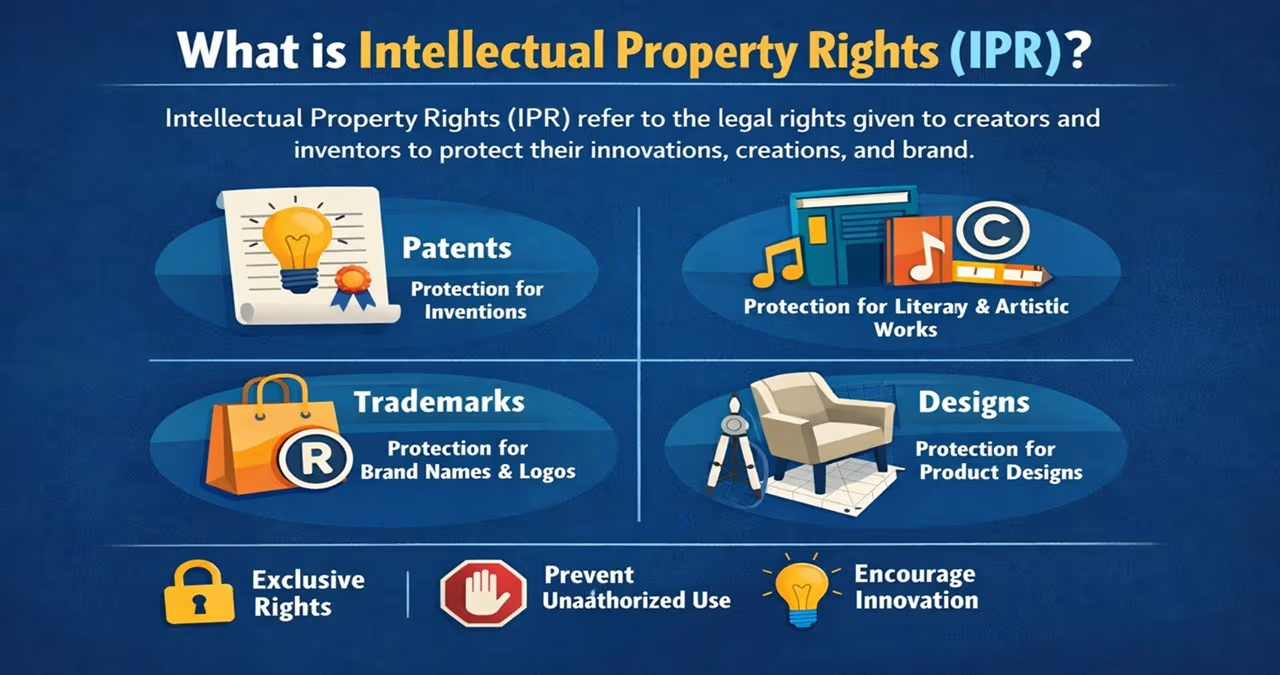
What is IPR? Meaning, 5 Important Types & IPR Laws in India: Intellectual Property Rights (IPR) are legal rights granted to a person over the creations of their mind. These creations may include inventions, brand names, logos, artistic works, literary works, industrial designs, symbols, and geographical indications. In simple words, IPR protects ideas that have commercial value. So What is Intellectual Property Rights? In simple words, Rights associated with Intellectual Property is known as Intellectual Property Rights.
In today’s knowledge-driven economy, intellectual property is as valuable as physical property. Companies invest heavily in research, branding, software, creative content, and product design. Without legal protection, these valuable assets could easily be copied or misused. That is why understanding Intellectual Property Rights is extremely important — especially for students preparing for CGPDTM, CGPDTM Patent Examiner Exam, UPSC Trademark Examiner, Patent Agent Exam, Trademark Agent Exam, Law Exams, Judiciary Exams, CLAT PG, Judiciary, PCS-J, CA Final, CS Professional, and CMA Final.
What is IPR? Meaning, 5 Important Types & IPR Laws in India
Meaning of IPR (What is Intellectual Property Rights)
The term “Intellectual Property” refers to intangible creations of the human intellect. Any property which Human mind creates in the field of Art, Science, literature, technology, etc. is known as Intellectual Property. When the law grants exclusive rights over such creations, those rights are known as Intellectual Property Rights.
Unlike physical property (like land or a house), intellectual property cannot be touched. It exists in the form of ideas, expressions, technical solutions, and distinctive identities. However, once protected by law, it becomes a powerful legal asset.
Intellectual Property Rights are exclusive legal rights given to creators to protect and commercially use their intellectual creations for a specific period. These rights prevent others from copying, using, selling, or commercially exploiting the creation without permission of the owner.
Want to understand how Intellectual Property Rights started and evolved globally? This video explains the complete origin of IPR in a simple and exam-oriented way.
Origin of IPR is a frequently asked topic in exams like CGPDTM, UPSC & Judiciary. Understanding this will strengthen your conceptual foundation.
So What is Intellectual Property Rights, and Why they Are Important?
Intellectual Property Rights play a crucial role in innovation, creativity, economic development, and fair competition. In a developing economy like India, IPR acts as a catalyst for technological advancement and entrepreneurship.
What is IPR & Its Importance?
-
Encourages innovation and scientific research
-
Protects creators from unfair copying and piracy
-
Promotes fair competition in the market
-
Helps businesses build brand identity and goodwill
-
Generates revenue through licensing and assignment
-
Attracts foreign investment and technology transfer
-
Supports startups and MSMEs in protecting their ideas
When inventors and creators know that their rights are protected, they are more willing to invest time, effort, and money into innovation.
Types of Intellectual Property Rights (IPR)
There are several types of Intellectual Property Rights recognized under Indian and international law. Each type protects a different form of intellectual creation. Basically there are 10 types of Intellectual Property, and the rights associated with it is known as Intellectual Property Rights.
- Patent
- Copyright
- Trademark
- Industrial Design
- Geographical Indications
- Trade Secret
- Traditional Knowledge
- Semiconductor Integrated Circuit Layout Design (SICLD)
- Protection of Plant Varieties & Farmers Rights (PPV&FR)
- Biological Diversity
1. Patent
A Patent protects inventions that are:
-
New (Novel)
-
Involve an inventive step (Non-obvious)
-
Capable of industrial application
Patents are crucial in technology-driven industries such as pharmaceuticals, biotechnology, engineering, and software-related innovations (where applicable).
Examples:
-
New pharmaceutical drugs
-
Mechanical inventions
-
Chemical compositions
-
Industrial processes
Governing Law in India:
👉 The Patents Act, 1970
Term of Protection:
👉 20 years from the filing date
A patent gives the patentee exclusive rights to make, use, sell, or import the invention in India.
For Patent Agent and CGPDTM aspirants, topics like patentability criteria, Section 3 exclusions, opposition, compulsory licensing, and infringement are extremely important.
Struggling with patent concepts like novelty, inventive step, and industrial applicability? Watch this video for a crystal-clear explanation.
Patent is one of the most important and high-weightage topics in IPR exams. Master this to easily solve MCQs and descriptive questions.
2. Trademark
A Trademark protects signs that distinguish goods or services of one person from another. It helps consumers identify the source and quality of products.
Examples:
-
Brand names like TATA, RELIANCE
-
Logos
-
Slogans
-
Sound marks
-
Shape marks
Governing Law:
👉 The Trade Marks Act, 1999
Term:
👉 10 years (renewable indefinitely)
Trademarks are extremely valuable business assets. They represent goodwill and brand reputation.
For Trademark Agent Exam and Trademark Examiner (UPSC), questions commonly appear on distinctiveness, absolute and relative grounds of refusal, opposition, rectification, and passing off.
Confused between trademark, brand, logo, and goodwill? This video will help you understand trademark concepts in the simplest way.
Trademark questions are very common in UPSC Trademark Examiner & Law exams. This video will boost your accuracy in MCQs.
3. Copyright
Copyright protects original literary, artistic, musical, and dramatic works. It protects the expression of ideas, not the ideas themselves.
Examples:
-
Books
-
Software
-
Films
-
Paintings
-
Music
-
Architectural works
Governing Law:
👉 The Copyright Act, 1957
Term:
👉 Lifetime of the author + 60 years (in most cases)
Copyright arises automatically upon creation of the work (registration is not mandatory but recommended for evidentiary value).
For CLAT PG, Judiciary, and UPSC, important areas include fair dealing, infringement, moral rights, and copyright in digital works.
Confused about what copyright actually means and how it protects your work? Watch this video to understand copyright in the simplest and most exam-focused way.
Copyright is one of the most important topics in IPR and is frequently asked in exams. Once you understand this concept, you can easily solve multiple MCQs.
4. Industrial Design
Design protection covers the aesthetic appearance of an article — not its functional aspects. It includes shape, configuration, pattern, ornamentation, or composition of lines or colors applied to an article.
Examples:
-
Unique bottle shape
-
Pattern on textiles
-
Shape of consumer electronics
Governing Law:
👉 The Designs Act, 2000
Term:
👉 10 years + 5 years extension
Design protection is particularly important in industries like fashion, automobile, packaging, and consumer goods.
Want to understand how design protection works and what exactly is protected under Industrial Design? This video explains it clearly.
Industrial Design is a scoring but often ignored topic. This video will help you cover it quickly and effectively for exams.
5. Geographical Indication (GI)
A Geographical Indication (GI) protects products that originate from a specific geographical location and possess qualities, reputation, or characteristics due to that location.
Examples:
-
Darjeeling Tea
-
Banarasi Saree
-
Kanchipuram Silk
Governing Law:
👉 The Geographical Indications of Goods (Registration and Protection) Act, 1999
GI protection promotes rural development, preserves traditional knowledge, and prevents misuse of regional product names.
Curious about how products like Darjeeling Tea or Banarasi Saree get special protection? Watch this video to understand GI in detail.
Geographical Indication is frequently asked in UPSC, Judiciary, and Law exams. This topic can give you easy marks if prepared well.
Intellectual Property Rights (IPR) Laws in India
India has a well-structured legal framework for IPR protection. The major laws are:
| IPR Type | Governing Act |
|---|---|
| Patent | The Patents Act, 1970 |
| Trademark | The Trade Marks Act, 1999 |
| Copyright | The Copyright Act, 1957 |
| Design | The Designs Act, 2000 |
| GI | The GI Act, 1999 |
What is IPR: History, Origin & Evolution of IP in India
Intellectual Property (IP) refers to a special category of property that is created by the application of human intellect (Human Mind) in fields such as science, literature, art, commerce and technology. Unlike tangible property like land or goods, IP is intangible in nature and exists as a product of the mind. Intellectual Property Rights (IPR) are the legal privileges granted to creators and inventors in exchange for disclosure of their creations to the public (Public Domain)n. These rights enable the inventor to use, sell, license, distribute and prevent unauthorized use of the invention. Importantly, IPR protects the intellectual creation itself and not merely the physical object in which it is embodied Broadly, Intellectual Property is divided into two major branches: Copyright and Related Rights, and Industrial Property Rights Copyright protects literary and artistic expressions such as books, music, films, architecture and software. Industrial Property, on the other hand, includes patents, trademarks, industrial designs and geographical indications. Over time, additional categories such as semiconductor layout designs, plant varieties and trade secrets have also been recognized under specialized legislations This classification reflects the expanding scope of human creativity and commercial innovation. The origin of Intellectual Property can be traced back to ancient civilizations. It is believed that around 500 BCE in Sybaris (Greece), creators were granted limited protection for new culinary inventions.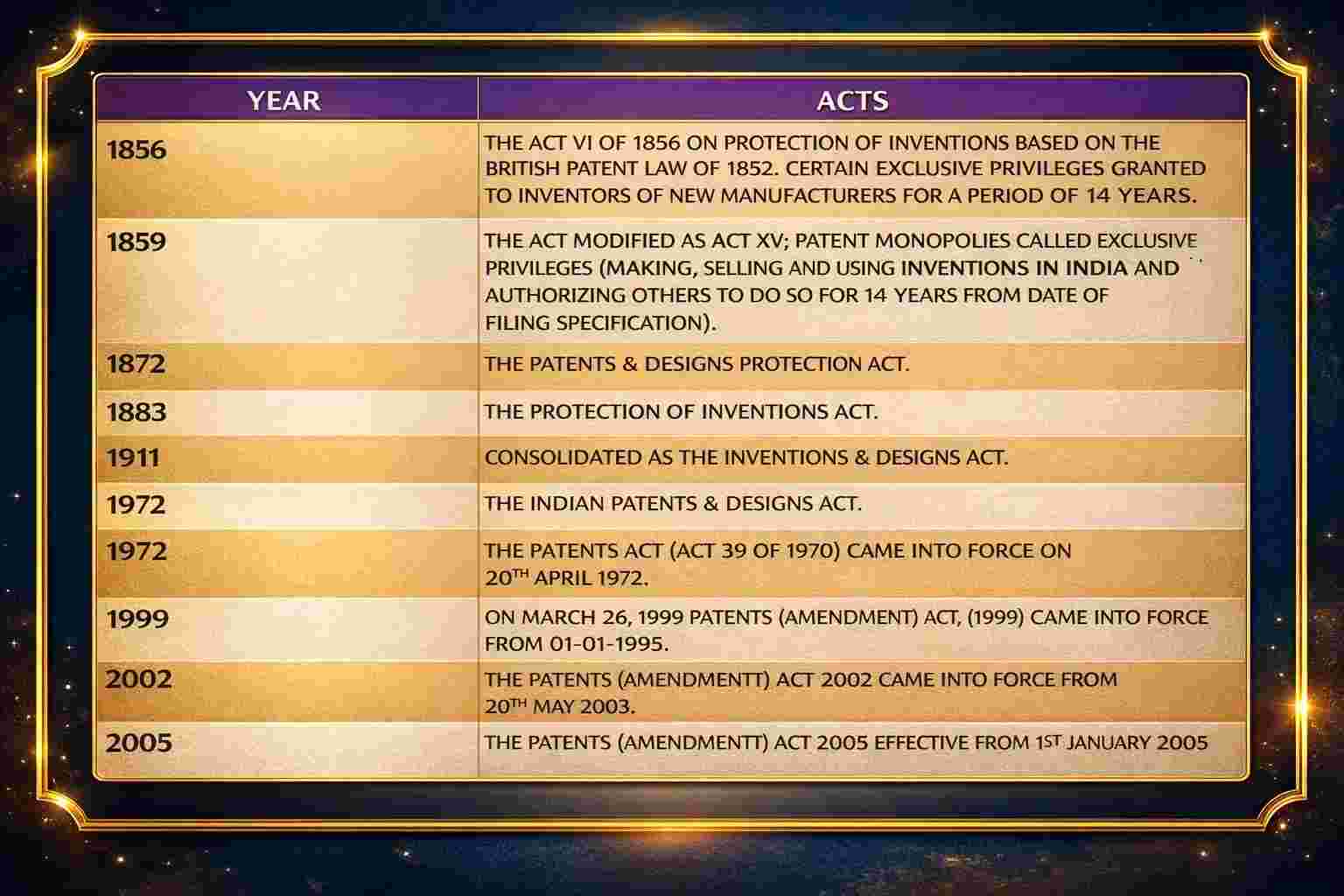 In England, the modern framework began to take shape with the Statute of Monopolies (1624), which granted exclusive rights to inventors for 14 years, followed by the Statute of Anne (1710), which laid the foundation of modern copyright law by granting rights to authors for reproduction and distribution of their works
By the 18th and 19th centuries, most European countries had enacted patent laws, marking the formal institutionalization of IPR worldwide.
In India, the evolution of IPR began during British rule. The first patent legislation was Act VI of 1856, based on the British Patent Law of 1852, granting “exclusive privileges” to inventors
This was followed by several amendments and enactments, including The Patterns and Designs Protection Act, 1872, and eventually The Indian Patents and Designs Act, 1911, which consolidated earlier laws.
After Independence, a comprehensive legislation was enacted as the Patents Act, 1970, which later underwent significant amendments in 1999, 2002 and 2005 to align with global standards and TRIPS obligations.
Parallel developments occurred in other areas of IP in India. Copyright was first introduced in 1847, later replaced by the Copyright Act, 1957, which has been amended six times in 1983, 1984, 1992, 1994, 1999, & 2012 to make process more fast & digital.
Trademark law evolved from the Trade Marks Act, 1940 to the Trade Marks Act, 1999
India also enacted the Geographical Indications of Goods (Registration and Protection) Act, 1999, the Designs Act, 2000, the Semiconductor Integrated Circuits Layout-Design Act, 2000, the Biological Diversity Act, 2002, and the PPV&FR Act, 2001 to comply with international agreements such as TRIPS.
Thus, the evolution of Intellectual Property reflects a gradual transition from informal protection of creativity to a structured and internationally harmonized legal regime. Today, IPR plays a crucial role in promoting innovation, encouraging disclosure, protecting investments and fostering economic growth. The journey from ancient monopolies to modern TRIPS-compliant legislation demonstrates how Intellectual Property has become an indispensable pillar of the global knowledge economy.
In England, the modern framework began to take shape with the Statute of Monopolies (1624), which granted exclusive rights to inventors for 14 years, followed by the Statute of Anne (1710), which laid the foundation of modern copyright law by granting rights to authors for reproduction and distribution of their works
By the 18th and 19th centuries, most European countries had enacted patent laws, marking the formal institutionalization of IPR worldwide.
In India, the evolution of IPR began during British rule. The first patent legislation was Act VI of 1856, based on the British Patent Law of 1852, granting “exclusive privileges” to inventors
This was followed by several amendments and enactments, including The Patterns and Designs Protection Act, 1872, and eventually The Indian Patents and Designs Act, 1911, which consolidated earlier laws.
After Independence, a comprehensive legislation was enacted as the Patents Act, 1970, which later underwent significant amendments in 1999, 2002 and 2005 to align with global standards and TRIPS obligations.
Parallel developments occurred in other areas of IP in India. Copyright was first introduced in 1847, later replaced by the Copyright Act, 1957, which has been amended six times in 1983, 1984, 1992, 1994, 1999, & 2012 to make process more fast & digital.
Trademark law evolved from the Trade Marks Act, 1940 to the Trade Marks Act, 1999
India also enacted the Geographical Indications of Goods (Registration and Protection) Act, 1999, the Designs Act, 2000, the Semiconductor Integrated Circuits Layout-Design Act, 2000, the Biological Diversity Act, 2002, and the PPV&FR Act, 2001 to comply with international agreements such as TRIPS.
Thus, the evolution of Intellectual Property reflects a gradual transition from informal protection of creativity to a structured and internationally harmonized legal regime. Today, IPR plays a crucial role in promoting innovation, encouraging disclosure, protecting investments and fostering economic growth. The journey from ancient monopolies to modern TRIPS-compliant legislation demonstrates how Intellectual Property has become an indispensable pillar of the global knowledge economy.
International Protection of IPR
Intellectual Property protection is not limited to national laws. Since trade is global, international treaties ensure cross-border protection.
Important International Agreements
-
TRIPS Agreement
-
Paris Convention
-
Berne Convention
-
Madrid Protocol
- Nice Agreement
India, being a member of the WTO, complies with TRIPS standards. These agreements ensure that intellectual property rights are recognized and enforced internationally.
International Treaties Related to IPR
World Intellectual Property Organization (WIPO) administers total 26 international treaties. 1.Paris Convention for the Protection of Industrial Property (1883) 2.Patent Cooperation Treaty (PCT), (1970) 3.Budapest Treaty on the International Recognition of the Deposit of Microorganism for Patent Procedure, (1977) 4.Trademark Law Treaty (TLT), (1994) 5.Patent Law Treaty (PLT), (2000) 6.Singapore Treaty on the Law of Trademarks, (2006) 7.Washington Treaty on Intellectual Property in Respect of Integrated Circuits, (1989) 8.Beijing Treaty on Audiovisual Performances, (2012) 9.Marrakesh VIP Treaty, (2013) 10.Nairobi Treaty on the Protection of the Olympic Symbol, (1981) 11.Brussels Convention Relating to the Distribution of Programme-Carrying Signals Transmitted by Satellite, (1974) 12.Madrid Agreement Concerning the International Registration of Marks (1891) 13.Madrid Protocol (1989) 14.Agreement for International Registration of Industrial Designs (AIRD), (1925) or Hague Agreement 15.Nice Agreement for the International Classification of Goods and Services for the Purposes of the Registration of Marks, (1957) 16. Lisbon Agreement for the Protection of Appellations of Origin and their International Registration, (1958) 17. Locarno Agreement Establishing an International Classification for Industrial Designs, (1968) 18. Strasbourg Agreement Concerning the International Patent Classification, (1971) 19. Rome Convention for the Protection of Performers, Producers of Phonograms and Broadcasting Organisations, (1961) 20. Berne Convention for the Protection of Literary and Artistic Works, (1886) 21. Geneva Convention for the Protection of Producers of Phonograms against Unauthorized Duplication of their Phonograms, (1971) or Phonogram Convention 22. WIPO Copyright Treaty (WCT), (1996) 23. WIPO Performances and Phonograms Treaty (WPPT),(1996) 24. WIPO Convention 25. Vienna Agreement, (1973) 26. Trade-Related Aspects of Intellectual Property Rights (TRIPS) Agreement, (1995)International treaties like TRIPS, Paris Convention, and Berne Convention can be confusing. This video simplifies all of them for you.
International IPR treaties are extremely important for exams like CGPDTM and UPSC. This video will help you revise them quickly.
Why International Treaties Became Important in Understanding What is IPR
When we try to understand what is IPR (Intellectual Property Rights), it is important to look at its global evolution. Around the mid-20th century, countries across the world started realizing the economic and creative value of intellectual property. As innovation increased, nations began creating their own domestic laws to protect inventors, authors, and artists. However, this independent approach created serious challenges. Each country had different rules regarding infringement, exceptions, duration of protection, and enforcement mechanisms. The lack of uniformity caused confusion, legal disputes, and dissatisfaction among creators. An inventor who wanted protection in multiple countries had to file separate applications in every jurisdiction. This process was not only expensive but also time-consuming and complex. To solve these problems and create harmony in the international IP system, major international treaties were introduced. Two landmark treaties were signed in France during the late 19th century: The Paris Convention – focusing on patents, trademarks, and industrial property. The Berne Convention – protecting literary and artistic works. These treaties laid the foundation for a structured and coordinated global IP framework. Over time, additional international agreements were adopted to regulate trademarks, industrial designs, geographical indications, appellations of origin, and even traditional knowledge. Today, the global IP system is largely administered by the World Intellectual Property Organization (WIPO), ensuring cooperation among member states. Understanding these developments helps clarify what is IPR and why international cooperation is essential. Intellectual property is no longer confined within national borders — innovation is global, and so must be its protection.| IP Category (India) | WIPO Category | Related Treaty | Year | Place | India Member Since |
|---|---|---|---|---|---|
| Patent | Patents | Patent Cooperation Treaty | 1970 | Washington | 1998 |
| Patent | Industrial Property (General) | Paris Convention for the Protection of Industrial Property | 1883 | Paris | 1998 |
| Copyright | Copyright | Berne Convention for the Protection of Literary and Artistic Works | 1886 | Berne | 1928 |
| Copyright | Copyright (Digital) | WIPO Copyright Treaty | 1996 | Geneva | 2018 |
| Copyright | Related Rights | WIPO Performances and Phonograms Treaty | 1996 | Geneva | 2018 |
| Trademarks | Trademarks | Madrid Protocol | 1989 | Madrid | 2013 |
| Trademarks | Industrial Property | Paris Convention for the Protection of Industrial Property | 1883 | Paris | 1998 |
| Industrial Designs | Industrial Designs | Hague Agreement | 1925 | The Hague | 2019 |
| Geographical Indications | Geographical Indications | Lisbon Agreement | 1958 | Lisbon | Not Member |
| SICLD (Semiconductor IC Layout) | Layout-Designs of Integrated Circuits | Washington Treaty on Intellectual Property in Respect of Integrated Circuits | 1989 | Washington | Not Member |
| Plant Varieties | Plant Varieties | International Convention for the Protection of New Varieties of Plants | 1961 | Paris | Not Member |
| Trade Secrets | Protection of Undisclosed Information | (Covered under TRIPS Agreement – WTO, not WIPO) | 1994 | Marrakesh | 1995 |
| Traditional Knowledge | — (Negotiation Stage) | No binding treaty yet (WIPO IGC discussions ongoing) | — | — | — |
| Biodiversity Conservation | Outside WIPO (Environmental Law) | Convention on Biological Diversity | 1992 | Rio de Janeiro | 1994 |
| All IP (Institutional Framework) | Institutional | WIPO Convention | 1967 | Stockholm | 1975 |
Role of CGPDTM in Intellectual Property Rights (IPR)
In India, Intellectual Property administration is handled by the Controller General of Patents, Designs and Trade Marks (CGPDTM).
Functions of CGPDTM
-
Granting Patents
-
Registering Trademarks
-
Registering Designs
-
Administering GI Registry
-
Supervising Patent & Trademark Offices
For candidates appearing in Patent Examiner and Trademark Examiner (UPSC), understanding the structure and powers of CGPDTM is essential.
Intellectual Property Rights (IPR) for Competitive Exams
Intellectual Property Rights (IPR) is an important and high-scoring subject in various competitive examinations because it combines legal principles with current developments in innovation, trade, and technology. It is particularly relevant for exams such as CGPDTM (Patent Examiner & Trademark Examiner), Patent Agent, Trademark Agent, UPSC, Judiciary, PCS-J, CLAT PG, and other law-related examinations, where questions are frequently asked on concepts like patents, trademarks, copyrights, geographical indications, TRIPS Agreement, and recent amendments in IP laws. The subject is not only theoretical but also practical, making it highly useful for both objective (MCQs) and descriptive papers.
Moreover, IPR has gained increasing importance due to globalization, digitalization, and India’s obligations under international agreements like the WTO-TRIPS framework. Competitive exams often test candidates on the historical evolution of IP laws in India, major amendments, landmark legislations, and contemporary policy updates. A clear conceptual understanding of IPR helps aspirants score better, especially because many questions are direct, fact-based, and linked to statutory provisions. Hence, mastering IPR provides a strategic advantage in multiple government and legal examinations.Exams Where IPR is Asked
CGPDTM Patent Examiner Exam, UPSC Trademark Examiner Exam, Patent Agent Exam, Trademark Agent Exam, Law Exams, Judiciary Exams, CLAT PG, CA Final, CS Professional, CMA Final
Most Asked Topics (Intellectual Property Laws in India)
Types of IPR (Patents, Copyright, Trademark, Geographical Indications, Industrial Design), IP Laws in India (Patents Act, 1970, Copyright Act, 1957, Design Act, 2000, GI Act, 1999, Trademarks Act, 1999, SICLD Act, 2000, PPV&FR Act, 2001, Biological Diversity Act, 2002), Term/Duration/Validity of protection, Difference between Patent & Trademark, Difference between Patent & Copyright, Difference between Trademark & Design, Difference between Trademark & Geographical Indication, Difference between Act & Rules, Subordinate Legislation/Delegated Legislation, Infringement and remedies, International treaties/convention, International agreements, World trade Organization (WTO), World Intellectual Property Organization (WIPO)
For aspirants of CGPDTM, CGPDTM Patent Examiner Exam, UPSC Trademark Examiner Exam, Patent Agent, Trademark Agent, UPSC, Law Exams, CLAT PG, Judiciary Exams, PCS-J, CA Final, CS Professional, and CMA Final, mastering these topics gives a clear competitive advantage.
Difference Between Intellectual Property & Physical Property
| Intellectual Property | Physical Property |
|---|---|
| Intangible | Tangible |
| Time-bound protection | Usually permanent |
| Based on creativity | Based on ownership |
| Requires registration (in many cases) | Ownership by possession/title |
Understanding this conceptual difference is important for writing mains answers and solving conceptual MCQs.
Intellectual Property Rights are the backbone of innovation and creativity in the modern economy. They protect inventions, brands, artistic works, designs, and traditional products from unauthorized use. By granting exclusive rights for a limited period, IPR balances private reward with public interest.
For students, professionals, entrepreneurs, and exam aspirants, understanding what is Intellectual Property Rights is not only academically important but also practically useful. With increasing emphasis on startups, Make in India, digital economy, and research-driven growth, IPR will continue to play a central role in India’s development.
If you are preparing for CGPDTM, Patent Agent, Trademark Agent, UPSC, Judiciary, Law Exams, CA, CS, or CMA, IPR is not optional — it is a scoring and career-defining subject.
Important Links
Follow IPR Guru on Social Media
| ▶ YouTube | ✖ Twitter (X) | |
| 📢 Telegram |
Frequently Asked Questions (FAQs)
What is the difference between Intellectual Property and Intellectual Property Rights?
What are the 5 main types of Intellectual Property Rights in India?
Which authority administers Intellectual Property Rights in India?
How is Trademark different from Geographical Indication (GI)?
What is the difference between Act and Rules in Intellectual Property law?
🎓 Join IPR Guru Academy
Register now to receive structured preparation for Patent Agent, Patent Examiner, Trademark Agent, and CGPDTM Exams, along with exclusive study resources, exam updates, and priority access to upcoming courses.
Register Now